ETA 1.4.16: Gary Goldman and Neil Miller failed to disclose their conflicts of interest to Human and Experimental Toxicology. The corrigendum is here.
oh goodness, here I wanted to go to bed early and then I stumbled over this latest "peer reviewed" paper in a journal "indexed by the National Library of Medicine" (see the anti-vaccine faction gloating at those fantastic quality indicators) and "proving" with an correlation co-efficient of 0.992 and a p of 0.0009 (so "sciencey") that:
Nations requiring the most vaccines tend to have the worst infant mortality rates
Authors of this little gem, in the journal Human & Experimental Toxicology, with the impressive impact factor of 1.307 and a proud ranking of 58th of 77 in the area of Toxicology (yes, that would put them into the bottom quarter) are Think Twice's own Neil Z. Miller and Medical Veritas' Gary S. Goldman. I wonder why Miller and Goldman didn't publish their paper in Medical Veritas (here is the link to the journal, please don't go blind), seeing that item 7 in their mission is: "Create a movement to address the adverse vaccine reactions and vaccine-related injuries afflicting children and adults". I guess that is because parents have clued in that "peer review" and being indexed on PubMed is a quality measure (although very obviously no guarantee for quality).
In any case - Miller and Goldman took a list of countries and looked at the number of vaccines they schedule for infants and they also looked at infant mortality. And then they correlated one with the other, a fail safe way to find causal relationships: Storks deliver babies p=0.008.
There are a number of things wrong with this procedure - first of all, the way Miller and Goldman are counting vaccines is completely arbitrary and riddled with mistakes.
Arbitrary: they count number of vaccines in US bins (DTaP is one, hib is separate) and non-specific designations (some "polio" is still given as OPV in Singapore), rather than antigens. If they did that, Japan, still giving the live bacterial vaccine BCG, would immediately go to the top of the list. That wouldn't fit the agenda, of course. But if you go by "shot" rather than by antigen, why are DTaP, IPV, hepB and hib counted as 4 shots for example in Austria, when they are given as Infanrix hexa, in one syringe?
Mistakes: The German childhood vaccination schedule recommends DTaP, hib, IPV AND hepB, as well as PCV at 2, 3 and 4 months, putting them squarely into the 21 - 23 bin. The fourth round of shots is recommended at 11 to 14 months, and MenC, MMR and Varicella are recommended with a lower age limit of 11 months, too, which means that a number of German kids will fall into the highest bin, at least as long as you count the Miller/Goldman way.
Then, they neatly put those arbitrarily counted doses into bins. Binning (i.e. grouping numbers before correlating them to something) always makes me suspicious. I don't have the time to check each country's vaccination schedule - I assume there will be mistakes in many claims, but I am guessing that if we plotted the infant mortality against the actual number of recommended vaccines, the correlation would be less good than engineered in this paper, i.e. the dose count above is probably not all that "arbitrary".
Then I noticed that the authors totally ignore historical trends. For example, in the early 1980ies, Germany's infant mortality was about 5 times as high (10000 infants died per year) than it is today (2000 died in 2009 with approximately the same birth rate), however (in Miller's and Goldman's twisted logic), the vaccination schedule contained far fewer vaccines in the first year (essentially just DT and polio, since the whole cell pertussis was not given between 1974 and 1991, the aP not yet introduced, the MMR given in year 2, no hib, nor hepB, nor PCV given either), while Germany was already very much a "developed country".
ETA: a similar point is made by Prometheus on Science based Medicine for the declining infant mortality rate in the US.
If I believed that one factor could ever explain something as complex as infant mortality, I would go and look at the relationship of maternity leave:
Japan, for example, generally gives 14 weeks at an average of 40% of a woman's salary and mothers are also entitled to childcare leave for their new baby's first year. Childcare laws dictate that in the first year of her baby's life, a mother may take two 30-minute breaks per day to care for her child (anyone else think breastfeeding?). She may also take time off any time during the baby's first year with one month's notice.
In Sweden, all working parents are entitled to up to 16 months of paid parental leave, Norway is similarly generous. Read the table and weep, US American parents!
In the bottom countries, the USA gives 0 months of parental leave, the FMLA offers some (up to 12 weeks) generally unpaid leave under very specific conditions. Heck - Botswana and Chad have better rules. Australia has 18 weeks (not months, like Norway) at minimal wage, but then, Canada, third worst in infant mortality has up to a year of parental leave at almost $2000 a month and that is where my crude correlation fails (although, if I binned some countries...a cunning plan).
ETA: Dr. Gorski picks up on some other flaws of this study - read his post.
In general, several large studies/meta-analyses NOT cited by Miller and Goldman, have indicated that if vaccines have anything to do with infant death, then as a protective factor, as this German study and meta-analysis and this large study from the UK.
To prevent SIDS (specified 10 May after comment):
put your baby "back to sleep"
do not smoke
breastfeed if at all possible (easier in countries with 18 months of paid maternity leave)
avoid loose bedding and soft mattresses or sofas
do not bed share when intoxicated, or smoker, or taking medicine that may make you drowsy, but keep your baby in your room
keep the sleep environment cool and don't overdress your baby
That is it.
Monday, May 9, 2011

Sunday, May 8, 2011
Still no independent confirmation of Wakefield's claims
One of the things that anti-vaccines groups desperately want to have, is the scientific support for their claims. A lot of parents know that rigorous studies, peer reviewed, published in scientific journals and indexed on Pubmed are the standard in discussions about medical care. Therefore, the anti-vaccine brigade are trying to maintain that, really, countless scientific studies across the globe have shown that vaccines are bad for you.
The anti-vaccine, pro-any-conspiracy theory website Whale.to (the citation of which automatically invokes Skopie's Law), provides a neat shopping list that staunch supporters of the long debunked “MMR causes inflammation of the gut which somehow causes autism and Andrew Wakefield is really a hero” notion can use to spam evidence based discussions, as recently seen on the Shot of Prevention blog where Marsha McClelland of the “We the People United for VaccineEducation Misinformation” Yahoo group copied and pasted in support for Andrew Wakefield.
She “writes”:
Note the buzz word “peer reviewed“ – also note the fundamental misconception that anyone would give a toss whether Wakefield believes that Wakefield was correct.
She goes on:
That – Martha and friends – is because no one (apart from Wakefield and his buddies) has ever been able to replicate Wakefield’s claims. I had previously looked at 5 studies supposedly „independently“ replicating Wakefield, but this list was 28 citations long (I guess the length is supposed to duly impress AND to keep anyone from checking). To quote Kenneth Branagh: “There is safety in numbers”. Luckily, both Chris and Liz Ditz were bothered enough to spend their valuable time to debunk the list (THANK YOU!) – I have created a synthesis of their and my previous searches and comments to create the “one stop copy and paste resource for the evidence minded”. Links add extra depth - sorry about the length, it may exceed the number of characters allowed for blog comments...
To summarize re-using Martha’s words: you may have been tricked into believing that Andrew Wakefield’s claims had been independently verified in 28 publications from 5 different countries. I’m afraid that is false. For those of you who have swallowed this type of reporting hook line and sinker, the below debunks each of the 28 studies from around the world that have been cited in his support.
1. The Journal of Pediatrics November 1999; 135(5):559-63 =
Horvath K., Papadimitriou J.C., Rabsztyn A., Drachenberg C., Tilden J.T. 1999. Gastrointestinal abnormalities in children with autism. J. Pediatrics 135: 559-563.
This study did not look for measles virus. Instead it looks at gastrointestinal (GI) malabsoption as an underlying mechanism for autism. It does not appear to have controls with autism & without GI symptoms OR controls without autism & with similar GI symptoms. Most children with autism & GI symptoms had upper GI problems such as reflux
This in no way “replicates” or “supports” Wakefield’s “findings”, which have been shown repeatedly to have been manufactured or the result of laboratory contamination.
2. The Journal of Pediatrics 2000; 138(3): 366-372 =
Furlano RI, Anthony A, Day R, Brown A, McGarvey L, Thomson MA, Davies SE, Berelowitz M, Forbes A, Wakefield AJ, Walker-Smith JA, Murch SH. Colonic CD8 and T cell filtration with epithelial damage in children with autism. J Pediatr 2001;138:366-72.
This paper claims to have "confirm[ed] a distinct lymphocytic colitis in autistic spectrum disorders", which is something that no other research groups find and has been the center of the recent GMC hearings against Wakefield. The extreme "engineering" towards a specific gut pathology has been summarized by Brian Deer.
Note the emergence of a theme: Wakefield is a co-author and no fewer than 7 of this paper's authors are also authors on the retracted paper in The Lancet; this paper cannot be said to independently ”replicate” or “support” Wakefield’s “findings”.
3. Journal of Clinical Immunology November 2003; 23(6): 504-517 =
Ashwood P, Anthony A, Pellicer AA, Torrente F, Wakefield AJ. Intestinal lymphocyte populations in children with regressive autism: evidence for extensive mucosal immunopathology. Journal of Clinical Immunology, 2003;23:504-517.
Again, this paper seeks to further claim "a pan-enteric mucosal immunopathology in children with regressive autism that is apparently distinct from other inflammatory bowel diseases", but we know that Wakefield et al. are the only researchers who have "found" this in the past 15 or so years.
Same theme: Wakefield (and Anthony) is a co-author; cannot be said to support his own work.
4. Journal of Neuroimmunology 2005
A meaningless citation as this would be a whole volume of a journal - this happens if you just copy and paste without any regard to the content. Supports nothing except maybe the notion that the anti-vaccine folk cannot cite biomedical literature properly.
If you go back to whale.to, John was kind enough to link to to the paper, which is
Ashwood P, Wakefield AJ. Immune activation of peripheral blood and mucosal CD3+ lymphocyte cytokine profiles in children with autism and gastrointestinal symptoms. J Neuroimmunol. 2006 Apr;173(1-2):126-34.
doesn't mention MMR, instead, the authors start from their own wrong premise "Gastrointestinal pathology, characterized by lymphoid nodular hyperplasia and entero-colitis, has been demonstrated in a cohort of children with autistic spectrum disorder (ASD)." and continue to find "In both peripheral blood and mucosa, [intracellular] CD3+ TNFalpha+ and CD3+ IFNgamma+ were increased in ASD children" ,
has Wakefield as senior author, therefore no independent replication of his results.
5. Brain, Behavior and Immunity 1993; 7: 97-103 =
Singh VK, Warren RP, Odell JD, Cole WP. Antibodies to myelin basic protein in children with autistic behavior. Brain, Behavior and Immunity 1993;7:97-103
Found some but not all children with autism had specific antibodies to myelin basic protein (MBP). Study did not look for measles virus, nor did study look for mumps or rubella virus or administration of the MMR.
It precedes the Lancet paper and in no way ”replicates” or “supports” Wakefield’s claims.
6. Pediatric Neurology 2003; 28(4): 1-3 Citation not found.
According to whale.to, this is
Singh VK, Jensen RL Elevated levels of measles antibodies in children with autism Pediatric Neurology 2003; 28(4): 292-294.
To the best of our knowledge, this study has not been replicated, and the findings refuted by several other studies, such as Baird G, Pickles A, Simonoff E, Charman T, Sullivan P, Chandler S, Loucas T, Meldrum D, Afzal M, Thomas B, Jin L, Brown D. Measles vaccination and antibody response in autism spectrum disorders. Arch Dis Child. 2008 Oct;93(10):832-7.
This study does not support Wakefield’s claims.
7. Neuropsychobiology 2005; 51:77-85 =
Jyonouchi H, Geng L, Ruby A, Zimmerman-Bier B. Dysregulated Innate Immune Responses in Young Children with Autism Spectrum Disorders: Their Relationship to Gastrointestinal Symptoms and Dietary Intervention. Neuropsychobiology. 2005;28:51 77-85
This study did not look for measles virus but evaluated inflammatory response to specific dietary proteins.
In no way ”replicates” or “supports” Wakefield’s “findings”
8. The Journal of Pediatrics May 2005;146(5):605-10 =
Jyonouchi H, Geng L, Ruby A, Reddy C, Zimmerman-Bier B. Evaluation of an association between gastrointestinal symptoms and cytokine production against common dietary proteins in children with autism spectrum disorders. J Pediatr.2005;146(5):605-10.
This study did not look for measles virus. Instead, the study evaluated inflammatory response to specific dietary proteins.
In no way ”replicates” or “supports” Wakefield’s “findings”
9. Autism Insights 2009; 1: 1-11 citation not found on PubMed, but this refers to Krigsman, A. , Boris, M., Goldblatt, A., Stott, C. Clinical presentation and histologic findings at ileocolonoscopy in children with autistic spectrum disorder and chronic gastrointestinal symptoms Autism Insights 2010:2 1-11.
Arthur Krigsman was a colleague of Andrew Wakefield at Thoughtful House, Wakefield and Carol Stott (a contributor to this paper) are editors of the vanity press journal Autism Insights (previously discussed on LBRB. Not very likely that this "peer review" was very tough.
In no way ”replicates” or “supports” Wakefield’s “findings”
10. Canadian Journal of Gastroenterology February 2009; 23(2): 95-98 =
Galiatsatos P, Gologan A, Lamoureux E, Autistic enterocolitis: Fact or fiction? Can J Gastroenterol. 2009:23:95-98
Case report, featuring two adult patients with gastrointestinal problems and ASD diagnoses. The authors call for “more investigations” in their discussion.
In no way ”replicates” or “supports” Wakefield’s “findings”
11. Annals of Clinical Psychiatry 2009:21(3): 148-161 =
Singh VK. Phenotypic expression of autoimmune autistic disorder (AAD): a major subset of autism. Ann Clin Psychiatry. 2009 Jul-Sep;21(3):148-61.
This paper makes assertions that are not supported by the evidence base in the paper. It is mainly a summary of research, with no mention of what children were looked at. Chris found the actual paper (https://www.aacp.com/Pages.asp?AID=7937&issue=&page=C&UID=), and among the data used it included a Wakefield paper = not independent. Also included in the references are papers from questionable journals like Journal of American Physicians and Surgeons and Medical Veritas, which all suddenly makes sense if you see that Singh is associated with these folk that tick the "our treatment heals everything" quack box (see one Singh study on PTSD).
This looks like it would support a connection between MMR and autism, but since no-one has independently reproduced this and the author stands to make money off the claims this review has to be viewed with extreme reservations.
12. Journal of Child Neurology June 29, 2009; 000:1-6 =
whale.to provides the pre-print, hence the missing volume and page numbers:
Genuis S.J., Bouchard, T.P. Celiac Disease Presenting as Autism, J Child Neurol January 2010 25(1):114-119
This paper proposes that many children with autism have celiac disease, that this causes micro nutrient deficiencies and that the behaviour of the children improves when you put them on a gluten free diet. No MMR mentioned.
Does not support Wakefield's claims.
13. Journal of Autism and Developmental Disorders March 2009;39(3):405-13 =
Nikolov RN, Bearss KE, Lettinga J, Erickson C, Rodowski M, Aman MG, McCracken JT, McDougle CJ, Tierney E, Vitiello B, Arnold LE, Shah B, Posey DJ, Ritz L, Scahill L. Gastrointestinal symptoms in a sample of children with pervasive developmental disorders. J Autism Dev Disord. 2009 Mar;39(3):405-13.
This study did not look for measles virus, nor did study look for mumps or rubella virus. Study evaluated children previously diagnosed with pervasive developmental disorders (PDDs) for gastrointestinal (GI) symptoms. 22.7% were found to exhibit GI symptoms, but were otherwise no different from subjects without GI problems in demographic characteristics, measures of adaptive functioning, or autism symptom severity.
In no way ”replicates” or “supports” Wakefield’s “findings”
14. Medical Hypotheses August 1998;51:133-144. =
Bolte, ER Autism and Clostridium tetani Medical Hypotheses August 1998;51:133-144.
Speculative paper presenting the hypothesis that autism symptoms are caused by a subacute, chronic tetanus infection
In no way ”replicates” or “supports” Wakefield’s “findings”
15. Journal of Child Neurology July 2000; ;15(7):429-35 =
Sandler RH, Finegold SM, Bolte ER, Buchanan CP, Maxwell AP, Väisänen ML, Nelson MN, Wexler HM. Short-term benefit from oral vancomycin treatment of regressive-onset autism. J Child Neurol. 2000;15:429-435
This study did not look for measles virus. Instead, this study evaluated 11 children’s response to a specific antibiotic. Gains faded following cessation of antibiotic.
In no way “replicates” or “supports” Wakefield’s “findings”
16. Lancet. 1972;2:883-884 =
Walker-Smith J, Andrews J. Alpha-1-antitrypsin, autism, and coeliac disease. Lancet. 1972 Oct 21;2(7782):883-4.
This is a "letter to the editor" published decades prior to the Wakefield Lancet paper and can hardly be said to “replicate” the latter. Walker-Smith and Andrews report on the investigation of alpha-1-antitrypsin levels in 8 children with autism vs in children with untreated and treated celiac disease and control children and finds levels in children with autism and celiac disease are similar. This has little to do with Wakefield or the MMR (it also predates the introduction of the MMR), however, Dr. Walker-Smith is a co-author of the retracted study in The Lancet.
In no way “replicates” or “supports” Wakefield’s “findings”
17. Journal of Autism and Childhood Schizophrenia January-March 1971;1:48-62 =
Goodwin MS, Cowen MA, Goodwin TC Malabsorption and cerebral dysfunction: a multivariate and comparative study of autistic children. J Autism Child Schizophr. 1971 Jan-Mar;1(1):48-62.
A paper published decades previously cannot be said to “replicate” a later paper, the paper predates the introduction of the MMR vaccine in the US, the authors are not concerned with vaccination at all, but is mainly concerned with finding distinguishing features between childhood autism and adult schizophrenia using a number of challenges and physiological measurement. One minor in their discussion is that "malabsorption" would lead to autistic behaviour, so more in the sense of paper 12.
In no way “replicates” or “supports” Wakefield’s “findings”
18. Journal of Pediatrics March 2001;138:366-372.
Same paper as #2 above. Wakefield and 6 others from the Lancet paper are co-authors; cannot be said to support their own work.
In no way ”replicates” or “supports” Wakefield’s “findings”
19. Molecular Psychiatry 2002;7:375-382. Torrente F., Machado N., Perez-Machado M., Furlano R., Thomson M., Davies S., Wakefield AJ, Walker-Smith JA, Murch SH. Enteropathy with T cell infiltration and epithelial IgG deposition in autism. Molecular Psychiatry. 2002;7:375-382.
Gosh, we know these guys – it’s Andy Wakefield and his colleagues from that paper in The Lancet, this time claiming IgG deposit in gut samples indicative of an autoimmune gut pathology and call me cynical, but I don't believe any of this, because it has only ever been seen by this group.
In no way ”replicates” or “supports” Wakefield’s “findings”
20. American Journal of Gastroenterolgy April 2004;598-605.=
Torrente F, Anthony A, Heuschkel RB, Thomson MA, Ashwood P, Murch SH. Focal-enhanced gastritis in regressive autism with features distinct from Crohn’s and Helicobacter pylori gastritis. Am J Gastroenterol. 2004;99:598-605
Murch SH, Anthony A, Thompson MA, Torrente F and Ashwood P were previous co-authors with Wakefield A. Again, there are no independent groups reporting similar findings and this does not look at MMR or any vaccine anyway.
In no way ”replicates” or “supports” Wakefield’s “findings”
21. Journal of Clinical Immunology November 2003;23:504-517 =
Ashwood P, Anthony A, Pellicer AA, Torrente F, Walker-Smith JA, Wakefield AJ. Intestinal lymphocyte populations in children with regressive autism: evidence for extensive mucosal immunopathology. J Clin Immunol. 2003 Nov;23(6):504-17.
We totally get it by now – Wakefield and Wakefield’s colleagues confirm their own results.
In no way ”replicates” or “supports” Wakefield’s “findings”
22. Neuroimmunology April 2006;173(1-2):126-34 =
Ashwood P, Wakefield AJ. Immune activation of peripheral blood and mucosal CD3+ lymphocyte cytokine profiles in children with autism and gastrointestinal symptoms. J Neuroimmunol. 2006;173(1-2):126-34.
same as number 4.
23. Prog. Neuropsychopharmacol Biol Psychiatry December 30 2006;30:1472-1477 =
Shinohe A, Hashimoto K, Nakamura K, Tsujii M, Iwata Y, Tsuchiyaa KJ, Sekine Y, Suda S, Suzuki K, Sugihara G, Matsuzaki H, Minabe Y, Sugiyama T, Masayoshi Kawai M, Iyo M,Takei N and Mori N Increased serum levels of glutamate in adult patients with autism- Progress in Neuro-Psychopharmacology and Biological Psychiatry Volume 30, Issue 8, 30 December 2006, Pages 1472-1477
Study of adults with autism on blood levels of amino acids, to assess whether altered glutamatergic neurotransmission was likely in autism. Study did not look for measles virus, nor did study look for mumps or rubella virus or anything connected with the gut.
In no way “replicates” or “supports” Wakefield’s “findings”
24. Clinical Infectious Diseases September 1 2002;35(Suppl 1):S6-S16 =
Finegold SM, Molitoris D, Song Y, Liu C, Vaisanen ML, Bolte E, McTeague M, Sandler R, Wexler H, Marlowe EM, Collins MD, Lawson PA, Summanen P, Baysallar M, Tomzynski TJ, Read E, Johnson E, Rolfe R, Nasir P, Shah H, Haake DA, Manning P, Kaul A. Gastrointestinal microflora studies in late-onset autism. Clin Infect Dis. 2002 Sep 1;35(Suppl 1):S6-S16.
Stool samples from children with regressive autism were compared to samples from children without autism; differences in stool flora were found. The study did not look for measles virus, nor did it look for mumps or rubella virus. Study did not evaluate changes in gut structure.
In no way “replicates” or “supports” Wakefield’s “findings”
25. Applied and Environmental Microbiology, 2004
Another of those citation snafus -
Song Y, Liu C, Finegold SM. Real-time PCR quantitation of clostridia in feces of autistic children. Appl Environ Microbiol. 2004 Nov;70(11):6459-65.
This study describes how to do PCR for specific bacteria on stool samples of autistic and non autistic children.
In no way “replicates” or “supports” Wakefield’s “findings”
26. Journal of Medical Microbiology October 2005;54:987-991 =
Parracho HM, Bingham MO, Gibson GR, McCartney AL. Differences between the gut microflora of children with autistic spectrum disorders and that of healthy children. J Med Microbiol. 2005 Oct;54(Pt 10):987-91.
More in the same vein: This study compared fecal flora for children with autism with two control groups: siblings without autism and unrelated children without autism. Minor differences were found. The study did not look for measles virus, nor did study look for mumps or rubella virus. Study did not evaluate changes in gut structure.
In no way “replicates” or “supports” Wakefield’s “findings”
27. Archivos venezolanos de puericultura y pediatría 2006; Vol 69 (1): 19-25. = González LG., López K, Navarro DC, Negrón L, Flores LS, Rodríguez R, Martínez M, Sabrá A. Características endoscópicas, histológicas e inmunológicas de la mucosa digestiva en niños autistas con síntomas gastrointestinales [Endoscopic and Histological Characteristics of the Digestive Mucosa in Autistic Children with gastro-Intestinal Symptoms] Archivos Venezolanos de Puericultura y Pediatría Enero-Marzo 2006, Volúmen 69, Número 1 Arch Venez Pueri Pediatr 2006 69(1):19-25. 1.
The authors cannot replicate Wakefield’s 1998 “findings” of a distinct autistic enterocolitis, although they do report a higher incidence of gastrointestinal problems in their autistic group. 2. It appears that the Gonzalez paper was funded by Thoughtful House, under Wakefield’s leadership as previously shown
In no way “replicates” or “supports” Wakefield’s “findings”
28. Gastroenterology. 2005:128 (Suppl 2);Abstract-303 =
Balzola F, Daniela C, Repici , Barbon V, Sapino A, Barbera C, Calvo PL, Gandione M, Rigardetto R*, and Rizzetto M .
This is a meeting abstract that has never been published as a peer reviewed study since 2005. Nine adult males with autism and GI symptoms were evaluated for GI disease. Study did not look for measles virus, nor did study look for mumps or rubella virus. Study did not evaluate changes in gut structure.
In no way “replicates” or “supports” Wakefield’s “findings”
Numbers: of 28 studies 2 were duplicates, 3 were only retrievable because of the links on the whale.to page, 13 were written by Wakefield and/or Lancet co-authors and/or Thoughful House colleagues (counting two duplicates), 3 predate the Lancet paper by years or even decades and not one independently replicates Wakefield’s claims, made in the retracted Lancet paper, the associated press conference and in many statements since.
The anti-vaccine, pro-any-conspiracy theory website Whale.to (the citation of which automatically invokes Skopie's Law), provides a neat shopping list that staunch supporters of the long debunked “MMR causes inflammation of the gut which somehow causes autism and Andrew Wakefield is really a hero” notion can use to spam evidence based discussions, as recently seen on the Shot of Prevention blog where Marsha McClelland of the “We the People United for Vaccine
She “writes”:
In the years after his initial controversial finding, linking the MMR vaccine to Crohn’s disease and autism, he published another 19 papers on the vaccine-induced disorder.
All were peer reviewed. However, strangely enough, none of these 19 papers are ever discussed in the media. The only study that keeps seeing the light of day is the original study from 1998, along with the original questions about conflicts of interest, which he explains in great detail in this interview. (my comment - that refers to the Mercola interview with Andrew Wakefield).
Note the buzz word “peer reviewed“ – also note the fundamental misconception that anyone would give a toss whether Wakefield believes that Wakefield was correct.
She goes on:
This is very interesting indeed, because not only has he continued his own studies, but since then, a large number of replication studies have been performed around the world, by other researchers, that confirm his initial findings.
It’s been replicated in Canada, in the US., in Venezuela, in Italy [but] they never get mentioned. All you ever hear is that no one else has ever been able to replicate the findings.
That – Martha and friends – is because no one (apart from Wakefield and his buddies) has ever been able to replicate Wakefield’s claims. I had previously looked at 5 studies supposedly „independently“ replicating Wakefield, but this list was 28 citations long (I guess the length is supposed to duly impress AND to keep anyone from checking). To quote Kenneth Branagh: “There is safety in numbers”. Luckily, both Chris and Liz Ditz were bothered enough to spend their valuable time to debunk the list (THANK YOU!) – I have created a synthesis of their and my previous searches and comments to create the “one stop copy and paste resource for the evidence minded”. Links add extra depth - sorry about the length, it may exceed the number of characters allowed for blog comments...
To summarize re-using Martha’s words: you may have been tricked into believing that Andrew Wakefield’s claims had been independently verified in 28 publications from 5 different countries. I’m afraid that is false. For those of you who have swallowed this type of reporting hook line and sinker, the below debunks each of the 28 studies from around the world that have been cited in his support.
1. The Journal of Pediatrics November 1999; 135(5):559-63 =
Horvath K., Papadimitriou J.C., Rabsztyn A., Drachenberg C., Tilden J.T. 1999. Gastrointestinal abnormalities in children with autism. J. Pediatrics 135: 559-563.
This study did not look for measles virus. Instead it looks at gastrointestinal (GI) malabsoption as an underlying mechanism for autism. It does not appear to have controls with autism & without GI symptoms OR controls without autism & with similar GI symptoms. Most children with autism & GI symptoms had upper GI problems such as reflux
This in no way “replicates” or “supports” Wakefield’s “findings”, which have been shown repeatedly to have been manufactured or the result of laboratory contamination.
2. The Journal of Pediatrics 2000; 138(3): 366-372 =
Furlano RI, Anthony A, Day R, Brown A, McGarvey L, Thomson MA, Davies SE, Berelowitz M, Forbes A, Wakefield AJ, Walker-Smith JA, Murch SH. Colonic CD8 and T cell filtration with epithelial damage in children with autism. J Pediatr 2001;138:366-72.
This paper claims to have "confirm[ed] a distinct lymphocytic colitis in autistic spectrum disorders", which is something that no other research groups find and has been the center of the recent GMC hearings against Wakefield. The extreme "engineering" towards a specific gut pathology has been summarized by Brian Deer.
Note the emergence of a theme: Wakefield is a co-author and no fewer than 7 of this paper's authors are also authors on the retracted paper in The Lancet; this paper cannot be said to independently ”replicate” or “support” Wakefield’s “findings”.
3. Journal of Clinical Immunology November 2003; 23(6): 504-517 =
Ashwood P, Anthony A, Pellicer AA, Torrente F, Wakefield AJ. Intestinal lymphocyte populations in children with regressive autism: evidence for extensive mucosal immunopathology. Journal of Clinical Immunology, 2003;23:504-517.
Again, this paper seeks to further claim "a pan-enteric mucosal immunopathology in children with regressive autism that is apparently distinct from other inflammatory bowel diseases", but we know that Wakefield et al. are the only researchers who have "found" this in the past 15 or so years.
Same theme: Wakefield (and Anthony) is a co-author; cannot be said to support his own work.
4. Journal of Neuroimmunology 2005
A meaningless citation as this would be a whole volume of a journal - this happens if you just copy and paste without any regard to the content. Supports nothing except maybe the notion that the anti-vaccine folk cannot cite biomedical literature properly.
If you go back to whale.to, John was kind enough to link to to the paper, which is
Ashwood P, Wakefield AJ. Immune activation of peripheral blood and mucosal CD3+ lymphocyte cytokine profiles in children with autism and gastrointestinal symptoms. J Neuroimmunol. 2006 Apr;173(1-2):126-34.
doesn't mention MMR, instead, the authors start from their own wrong premise "Gastrointestinal pathology, characterized by lymphoid nodular hyperplasia and entero-colitis, has been demonstrated in a cohort of children with autistic spectrum disorder (ASD)." and continue to find "In both peripheral blood and mucosa, [intracellular] CD3+ TNFalpha+ and CD3+ IFNgamma+ were increased in ASD children" ,
has Wakefield as senior author, therefore no independent replication of his results.
5. Brain, Behavior and Immunity 1993; 7: 97-103 =
Singh VK, Warren RP, Odell JD, Cole WP. Antibodies to myelin basic protein in children with autistic behavior. Brain, Behavior and Immunity 1993;7:97-103
Found some but not all children with autism had specific antibodies to myelin basic protein (MBP). Study did not look for measles virus, nor did study look for mumps or rubella virus or administration of the MMR.
It precedes the Lancet paper and in no way ”replicates” or “supports” Wakefield’s claims.
6. Pediatric Neurology 2003; 28(4): 1-3 Citation not found.
According to whale.to, this is
Singh VK, Jensen RL Elevated levels of measles antibodies in children with autism Pediatric Neurology 2003; 28(4): 292-294.
To the best of our knowledge, this study has not been replicated, and the findings refuted by several other studies, such as Baird G, Pickles A, Simonoff E, Charman T, Sullivan P, Chandler S, Loucas T, Meldrum D, Afzal M, Thomas B, Jin L, Brown D. Measles vaccination and antibody response in autism spectrum disorders. Arch Dis Child. 2008 Oct;93(10):832-7.
This study does not support Wakefield’s claims.
7. Neuropsychobiology 2005; 51:77-85 =
Jyonouchi H, Geng L, Ruby A, Zimmerman-Bier B. Dysregulated Innate Immune Responses in Young Children with Autism Spectrum Disorders: Their Relationship to Gastrointestinal Symptoms and Dietary Intervention. Neuropsychobiology. 2005;28:51 77-85
This study did not look for measles virus but evaluated inflammatory response to specific dietary proteins.
In no way ”replicates” or “supports” Wakefield’s “findings”
8. The Journal of Pediatrics May 2005;146(5):605-10 =
Jyonouchi H, Geng L, Ruby A, Reddy C, Zimmerman-Bier B. Evaluation of an association between gastrointestinal symptoms and cytokine production against common dietary proteins in children with autism spectrum disorders. J Pediatr.2005;146(5):605-10.
This study did not look for measles virus. Instead, the study evaluated inflammatory response to specific dietary proteins.
In no way ”replicates” or “supports” Wakefield’s “findings”
9. Autism Insights 2009; 1: 1-11 citation not found on PubMed, but this refers to Krigsman, A. , Boris, M., Goldblatt, A., Stott, C. Clinical presentation and histologic findings at ileocolonoscopy in children with autistic spectrum disorder and chronic gastrointestinal symptoms Autism Insights 2010:2 1-11.
Arthur Krigsman was a colleague of Andrew Wakefield at Thoughtful House, Wakefield and Carol Stott (a contributor to this paper) are editors of the vanity press journal Autism Insights (previously discussed on LBRB. Not very likely that this "peer review" was very tough.
In no way ”replicates” or “supports” Wakefield’s “findings”
10. Canadian Journal of Gastroenterology February 2009; 23(2): 95-98 =
Galiatsatos P, Gologan A, Lamoureux E, Autistic enterocolitis: Fact or fiction? Can J Gastroenterol. 2009:23:95-98
Case report, featuring two adult patients with gastrointestinal problems and ASD diagnoses. The authors call for “more investigations” in their discussion.
In no way ”replicates” or “supports” Wakefield’s “findings”
11. Annals of Clinical Psychiatry 2009:21(3): 148-161 =
Singh VK. Phenotypic expression of autoimmune autistic disorder (AAD): a major subset of autism. Ann Clin Psychiatry. 2009 Jul-Sep;21(3):148-61.
This paper makes assertions that are not supported by the evidence base in the paper. It is mainly a summary of research, with no mention of what children were looked at. Chris found the actual paper (https://www.aacp.com/Pages.asp?AID=7937&issue=&page=C&UID=), and among the data used it included a Wakefield paper = not independent. Also included in the references are papers from questionable journals like Journal of American Physicians and Surgeons and Medical Veritas, which all suddenly makes sense if you see that Singh is associated with these folk that tick the "our treatment heals everything" quack box (see one Singh study on PTSD).
This looks like it would support a connection between MMR and autism, but since no-one has independently reproduced this and the author stands to make money off the claims this review has to be viewed with extreme reservations.
12. Journal of Child Neurology June 29, 2009; 000:1-6 =
whale.to provides the pre-print, hence the missing volume and page numbers:
Genuis S.J., Bouchard, T.P. Celiac Disease Presenting as Autism, J Child Neurol January 2010 25(1):114-119
This paper proposes that many children with autism have celiac disease, that this causes micro nutrient deficiencies and that the behaviour of the children improves when you put them on a gluten free diet. No MMR mentioned.
Does not support Wakefield's claims.
13. Journal of Autism and Developmental Disorders March 2009;39(3):405-13 =
Nikolov RN, Bearss KE, Lettinga J, Erickson C, Rodowski M, Aman MG, McCracken JT, McDougle CJ, Tierney E, Vitiello B, Arnold LE, Shah B, Posey DJ, Ritz L, Scahill L. Gastrointestinal symptoms in a sample of children with pervasive developmental disorders. J Autism Dev Disord. 2009 Mar;39(3):405-13.
This study did not look for measles virus, nor did study look for mumps or rubella virus. Study evaluated children previously diagnosed with pervasive developmental disorders (PDDs) for gastrointestinal (GI) symptoms. 22.7% were found to exhibit GI symptoms, but were otherwise no different from subjects without GI problems in demographic characteristics, measures of adaptive functioning, or autism symptom severity.
In no way ”replicates” or “supports” Wakefield’s “findings”
14. Medical Hypotheses August 1998;51:133-144. =
Bolte, ER Autism and Clostridium tetani Medical Hypotheses August 1998;51:133-144.
Speculative paper presenting the hypothesis that autism symptoms are caused by a subacute, chronic tetanus infection
In no way ”replicates” or “supports” Wakefield’s “findings”
15. Journal of Child Neurology July 2000; ;15(7):429-35 =
Sandler RH, Finegold SM, Bolte ER, Buchanan CP, Maxwell AP, Väisänen ML, Nelson MN, Wexler HM. Short-term benefit from oral vancomycin treatment of regressive-onset autism. J Child Neurol. 2000;15:429-435
This study did not look for measles virus. Instead, this study evaluated 11 children’s response to a specific antibiotic. Gains faded following cessation of antibiotic.
In no way “replicates” or “supports” Wakefield’s “findings”
16. Lancet. 1972;2:883-884 =
Walker-Smith J, Andrews J. Alpha-1-antitrypsin, autism, and coeliac disease. Lancet. 1972 Oct 21;2(7782):883-4.
This is a "letter to the editor" published decades prior to the Wakefield Lancet paper and can hardly be said to “replicate” the latter. Walker-Smith and Andrews report on the investigation of alpha-1-antitrypsin levels in 8 children with autism vs in children with untreated and treated celiac disease and control children and finds levels in children with autism and celiac disease are similar. This has little to do with Wakefield or the MMR (it also predates the introduction of the MMR), however, Dr. Walker-Smith is a co-author of the retracted study in The Lancet.
In no way “replicates” or “supports” Wakefield’s “findings”
17. Journal of Autism and Childhood Schizophrenia January-March 1971;1:48-62 =
Goodwin MS, Cowen MA, Goodwin TC Malabsorption and cerebral dysfunction: a multivariate and comparative study of autistic children. J Autism Child Schizophr. 1971 Jan-Mar;1(1):48-62.
A paper published decades previously cannot be said to “replicate” a later paper, the paper predates the introduction of the MMR vaccine in the US, the authors are not concerned with vaccination at all, but is mainly concerned with finding distinguishing features between childhood autism and adult schizophrenia using a number of challenges and physiological measurement. One minor in their discussion is that "malabsorption" would lead to autistic behaviour, so more in the sense of paper 12.
In no way “replicates” or “supports” Wakefield’s “findings”
18. Journal of Pediatrics March 2001;138:366-372.
Same paper as #2 above. Wakefield and 6 others from the Lancet paper are co-authors; cannot be said to support their own work.
In no way ”replicates” or “supports” Wakefield’s “findings”
19. Molecular Psychiatry 2002;7:375-382. Torrente F., Machado N., Perez-Machado M., Furlano R., Thomson M., Davies S., Wakefield AJ, Walker-Smith JA, Murch SH. Enteropathy with T cell infiltration and epithelial IgG deposition in autism. Molecular Psychiatry. 2002;7:375-382.
Gosh, we know these guys – it’s Andy Wakefield and his colleagues from that paper in The Lancet, this time claiming IgG deposit in gut samples indicative of an autoimmune gut pathology and call me cynical, but I don't believe any of this, because it has only ever been seen by this group.
In no way ”replicates” or “supports” Wakefield’s “findings”
20. American Journal of Gastroenterolgy April 2004;598-605.=
Torrente F, Anthony A, Heuschkel RB, Thomson MA, Ashwood P, Murch SH. Focal-enhanced gastritis in regressive autism with features distinct from Crohn’s and Helicobacter pylori gastritis. Am J Gastroenterol. 2004;99:598-605
Murch SH, Anthony A, Thompson MA, Torrente F and Ashwood P were previous co-authors with Wakefield A. Again, there are no independent groups reporting similar findings and this does not look at MMR or any vaccine anyway.
In no way ”replicates” or “supports” Wakefield’s “findings”
21. Journal of Clinical Immunology November 2003;23:504-517 =
Ashwood P, Anthony A, Pellicer AA, Torrente F, Walker-Smith JA, Wakefield AJ. Intestinal lymphocyte populations in children with regressive autism: evidence for extensive mucosal immunopathology. J Clin Immunol. 2003 Nov;23(6):504-17.
We totally get it by now – Wakefield and Wakefield’s colleagues confirm their own results.
In no way ”replicates” or “supports” Wakefield’s “findings”
22. Neuroimmunology April 2006;173(1-2):126-34 =
Ashwood P, Wakefield AJ. Immune activation of peripheral blood and mucosal CD3+ lymphocyte cytokine profiles in children with autism and gastrointestinal symptoms. J Neuroimmunol. 2006;173(1-2):126-34.
same as number 4.
23. Prog. Neuropsychopharmacol Biol Psychiatry December 30 2006;30:1472-1477 =
Shinohe A, Hashimoto K, Nakamura K, Tsujii M, Iwata Y, Tsuchiyaa KJ, Sekine Y, Suda S, Suzuki K, Sugihara G, Matsuzaki H, Minabe Y, Sugiyama T, Masayoshi Kawai M, Iyo M,Takei N and Mori N Increased serum levels of glutamate in adult patients with autism- Progress in Neuro-Psychopharmacology and Biological Psychiatry Volume 30, Issue 8, 30 December 2006, Pages 1472-1477
Study of adults with autism on blood levels of amino acids, to assess whether altered glutamatergic neurotransmission was likely in autism. Study did not look for measles virus, nor did study look for mumps or rubella virus or anything connected with the gut.
In no way “replicates” or “supports” Wakefield’s “findings”
24. Clinical Infectious Diseases September 1 2002;35(Suppl 1):S6-S16 =
Finegold SM, Molitoris D, Song Y, Liu C, Vaisanen ML, Bolte E, McTeague M, Sandler R, Wexler H, Marlowe EM, Collins MD, Lawson PA, Summanen P, Baysallar M, Tomzynski TJ, Read E, Johnson E, Rolfe R, Nasir P, Shah H, Haake DA, Manning P, Kaul A. Gastrointestinal microflora studies in late-onset autism. Clin Infect Dis. 2002 Sep 1;35(Suppl 1):S6-S16.
Stool samples from children with regressive autism were compared to samples from children without autism; differences in stool flora were found. The study did not look for measles virus, nor did it look for mumps or rubella virus. Study did not evaluate changes in gut structure.
In no way “replicates” or “supports” Wakefield’s “findings”
25. Applied and Environmental Microbiology, 2004
Another of those citation snafus -
Song Y, Liu C, Finegold SM. Real-time PCR quantitation of clostridia in feces of autistic children. Appl Environ Microbiol. 2004 Nov;70(11):6459-65.
This study describes how to do PCR for specific bacteria on stool samples of autistic and non autistic children.
In no way “replicates” or “supports” Wakefield’s “findings”
26. Journal of Medical Microbiology October 2005;54:987-991 =
Parracho HM, Bingham MO, Gibson GR, McCartney AL. Differences between the gut microflora of children with autistic spectrum disorders and that of healthy children. J Med Microbiol. 2005 Oct;54(Pt 10):987-91.
More in the same vein: This study compared fecal flora for children with autism with two control groups: siblings without autism and unrelated children without autism. Minor differences were found. The study did not look for measles virus, nor did study look for mumps or rubella virus. Study did not evaluate changes in gut structure.
In no way “replicates” or “supports” Wakefield’s “findings”
27. Archivos venezolanos de puericultura y pediatría 2006; Vol 69 (1): 19-25. = González LG., López K, Navarro DC, Negrón L, Flores LS, Rodríguez R, Martínez M, Sabrá A. Características endoscópicas, histológicas e inmunológicas de la mucosa digestiva en niños autistas con síntomas gastrointestinales [Endoscopic and Histological Characteristics of the Digestive Mucosa in Autistic Children with gastro-Intestinal Symptoms] Archivos Venezolanos de Puericultura y Pediatría Enero-Marzo 2006, Volúmen 69, Número 1 Arch Venez Pueri Pediatr 2006 69(1):19-25. 1.
The authors cannot replicate Wakefield’s 1998 “findings” of a distinct autistic enterocolitis, although they do report a higher incidence of gastrointestinal problems in their autistic group. 2. It appears that the Gonzalez paper was funded by Thoughtful House, under Wakefield’s leadership as previously shown
In no way “replicates” or “supports” Wakefield’s “findings”
28. Gastroenterology. 2005:128 (Suppl 2);Abstract-303 =
Balzola F, Daniela C, Repici , Barbon V, Sapino A, Barbera C, Calvo PL, Gandione M, Rigardetto R*, and Rizzetto M .
This is a meeting abstract that has never been published as a peer reviewed study since 2005. Nine adult males with autism and GI symptoms were evaluated for GI disease. Study did not look for measles virus, nor did study look for mumps or rubella virus. Study did not evaluate changes in gut structure.
In no way “replicates” or “supports” Wakefield’s “findings”
Numbers: of 28 studies 2 were duplicates, 3 were only retrievable because of the links on the whale.to page, 13 were written by Wakefield and/or Lancet co-authors and/or Thoughful House colleagues (counting two duplicates), 3 predate the Lancet paper by years or even decades and not one independently replicates Wakefield’s claims, made in the retracted Lancet paper, the associated press conference and in many statements since.
Tuesday, May 3, 2011
Death by measles
I just found the news that a young man died of measles in Germany this Spring. Germany has had more than 390 measles cases since the beginning of the year, mainly in the Southern most federal states (Bundesländer) of Bavaria and Baden-Württemberg.
In March 2011, a 26 year old man, undergoing treatment for a non life threatening tumour contracted measles and died. While in hospital, he infected at least one further patient as well as several unvaccinated medical staff, including doctors. Dr. Martin Terhardt of the Professional Association of Pediatricians (Berufsverband der Kinder- und Jugendärzte (BVKJ)) states the obvious:
Measles transmissions in a medical care setting seem to have become the norm rather than the exception (see California and Arizona 2008). In the light of the current strong measles activity in Europe (with world wide exports), everyone, especially care professionals, should check their immunization status and get boosters if necessary to avoid transmission (especially to vulnerable babies and immuno-suppressed).
In March 2011, a 26 year old man, undergoing treatment for a non life threatening tumour contracted measles and died. While in hospital, he infected at least one further patient as well as several unvaccinated medical staff, including doctors. Dr. Martin Terhardt of the Professional Association of Pediatricians (Berufsverband der Kinder- und Jugendärzte (BVKJ)) states the obvious:
"It is unacceptable that unvaccinated personnel exists in hospitals. When unvaccinated doctors or nurses have access to intensive care, it becomes very dangerous, both for the personnel themselves and for the patients. Patients who are being treated in intensive care are often immuno-compromised - an additional infection therefore has to be avoided at all cost. Doctors and other medical care personnel must have adequate protection through immunization. The fact that a patient with measles could cause an outbreak amongst medical personnel is absurd."
Measles transmissions in a medical care setting seem to have become the norm rather than the exception (see California and Arizona 2008). In the light of the current strong measles activity in Europe (with world wide exports), everyone, especially care professionals, should check their immunization status and get boosters if necessary to avoid transmission (especially to vulnerable babies and immuno-suppressed).
Wednesday, April 6, 2011
Pertussis Closes Waldorf-Based Private School in Virginia
A whooping cough outbreak hitting more than half (23 of 45) their pupils has led to the closure of that small private school for a week. The local Health Care Director unambiguously stated that lack of vaccinations caused this outbreak and that the children who were affected were unvaccinated (7 adult contacts also got the disease).
This outbreak is demonstrating two things - disease outbreaks happen in "pockets" of unvaccinated children, and, those "pockets" are often found in Waldorf/Steiner oriented institutions (for a comprehensive critical introduction into Anthroposophy, read the three part series on DC's Improbable Science blog). Indeed, the last whooping cough outbreak I personally saw was in the Steiner Kindi in two streets down from where we lived in Germany. The daycare director interpreted the outbreak as "the children seeking disease, because they needed a break" and proposed to close the Kindi for three weeks (a plan curbed by the working moms whose children attending the facility had been vaccinated and were just fine). What a break that was, with several children needing a 3 week residential rehab to learn how to breathe normally again... I'd rather pay money for a break than health, but that may be just me.
Similarly, quite impressive measles outbreaks in (mostly German speaking) countries have started in Steiner schools and Kindergartens and were sometimes specifically centered around Anthroposophical doctors with ananti-vaccine vaccine-critical outlook. Steiner himself deemed rashy diseases, like measles and Scarlet fever, which in his life time each killed a large percentage of the annual birth cohort, important for the development of proper karma and the shedding of bad miasms (don't ask - read link above, it is weirder than you think and weirder than you would expect any contemporary parent to believe and doctor to peddle).
The good news is that school and parents are complying with the suggested quarantine and/or treatment measures to limit transmission. Hopefully, some of them will research the "crunchy, holistic" philosophy behind their school and their vaccine refusal a bit more carefully, too.
This outbreak is demonstrating two things - disease outbreaks happen in "pockets" of unvaccinated children, and, those "pockets" are often found in Waldorf/Steiner oriented institutions (for a comprehensive critical introduction into Anthroposophy, read the three part series on DC's Improbable Science blog). Indeed, the last whooping cough outbreak I personally saw was in the Steiner Kindi in two streets down from where we lived in Germany. The daycare director interpreted the outbreak as "the children seeking disease, because they needed a break" and proposed to close the Kindi for three weeks (a plan curbed by the working moms whose children attending the facility had been vaccinated and were just fine). What a break that was, with several children needing a 3 week residential rehab to learn how to breathe normally again... I'd rather pay money for a break than health, but that may be just me.
Similarly, quite impressive measles outbreaks in (mostly German speaking) countries have started in Steiner schools and Kindergartens and were sometimes specifically centered around Anthroposophical doctors with an
The good news is that school and parents are complying with the suggested quarantine and/or treatment measures to limit transmission. Hopefully, some of them will research the "crunchy, holistic" philosophy behind their school and their vaccine refusal a bit more carefully, too.
Saturday, April 2, 2011
2008: Measles in Dr. Bob Sears' Waiting Room
I thought this to be a timely topic given the current measles outbreak that is occurring in a very undervaccinated population in Minnesota. Thus far, there are 14 cases in Hennepin County, 13 of which are epidemiologically-linked in the Somali population there. This situation highlights the infectiousness of measles and how easily it can be spread to immunologically-naive people, even with overall high vaccination rates. Uptake of MMR is estimated to be greater than 95% in 70% of U.S. schools, however, private schools are not surveyed and 12 states were below 95% with some as low as 81%. There is also geographical clustering of "like-minded" people in communities that leave large numbers of susceptible children at risk for measles. Additionally, lists of "vaccine-friendly" doctors, like this one provided by Dr. Bob can be geographically-linked to large numbers of school exemptions for vaccines.
This is what can, has and will happen again with the current recommendations that these "vaccine-friendly" doctors make: In 2008, an intentionally unvaccinated 7 year old child came back to the states from a visit to Switzerland with his parents.
In reality however, there were three infants and one toddler who contracted measles in his waiting room. Here is the story of the one who ended up in the hospital:
One would think this would be a humbling and educational experience for someone like Dr. Bob, but it wasn't. In his 2008 blog about the San Diego measles outbreak, he callously dismissed the measles outbreak:
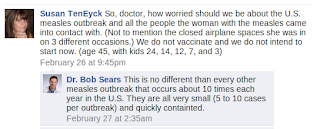 Public health officials will be there to help clean up the mess that disease-friendly doctors like Dr. Bob create, instead of promoting prevention. I am fully supportive of parents' right to choose vaccination schedules, however, choices need to be more responsible and "vaccine-friendly" doctors need to stop disseminating false information and validating poor vaccine choices. To use the words of anti-vaxx spokesperson, Jenny McCarthy:
The next time you are looking for a measles party, or chicken pox, rubella, Hib, pertussis or mumps, no need to organise it with your local mummy forum, just stop by Dr. Sears' office or one of his disease-friendly associates offices on his list. But you may want to go see a more competent physician if you actually want a proper diagnosis after the fact. And even better, one who makes house-calls.
EDITED BY Catherina ON 6/6/2011 to add a comment from Dr. Bob made on his Facebook group:
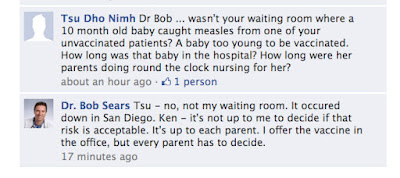
Seems he lucked out there...
This is what can, has and will happen again with the current recommendations that these "vaccine-friendly" doctors make: In 2008, an intentionally unvaccinated 7 year old child came back to the states from a visit to Switzerland with his parents.
In January 2008, measles was identified in an unvaccinated boy from San Diego, California, who had recently traveled to Europe with his family. After his case was confirmed, an outbreak investigation and response were initiated by local and state health departments in coordination with CDC, using standard measles surveillance case definitions and classifications.* This report summarizes the preliminary results of that investigation, which has identified 11 additional cases of measles in unvaccinated children in San Diego that are linked epidemiologically to the index case and include two generations of secondary transmission. Recommendations for preventing further measles transmission from importations in this and other U.S. settings include reminding health-care providers to 1) consider a diagnosis of measles in ill persons who have traveled overseas, 2) use appropriate infection-control practices to prevent transmission in health-care settings, and 3) maintain high coverage with measles, mumps, and rubella (MMR) vaccine among children.Just the Vax reported earlier that the index case (the intentionally unvaccinated boy travelling from Switzerland) was Dr. Bob Sears' patient. But there is now more. That boy, the index case, infected four other children in the waiting room of his paediatrician's office. The office of Dr. Bob Sears. I suspected this was the case and it was confirmed when Dr. Bob appeared on the Dr. Oz Show, "What Causes Autism" with Dr. Ari Brown who stated:
The index patient was an unvaccinated boy aged 7 years who had visited Switzerland with his family, returning to the United States on January 13, 2008. He had fever and sore throat on January 21, followed by cough, coryza, and conjunctivitis. On January 24, he attended school. On January 25, the date of his rash onset, he visited the offices of his family physician and his pediatrician. A diagnosis of scarlet fever was ruled out on the basis of a negative rapid test for streptococcus. When the boy's condition became worse on January 26, he visited a children's hospital inpatient laboratory, where blood specimens were collected for measles antibody testing; later that day, he was taken to the same hospital's emergency department because of high fever 104°F (40°C) and generalized rash. No isolation precautions were instituted at the doctors' offices or hospital facilities.
The boy's measles immunoglobulin M (IgM) positive laboratory test result was reported to the county health department on February 1, 2008. During January 31--February 19, a total of 11 additional measles cases in unvaccinated infants and children aged 10 months--9 years were identified. These 11 cases included both of the index patient's siblings (rash onset: February 3), five children in his school (rash onset: January 31--February 17), and four additional children (rash onset: February 6--10) who had been in the pediatrician's office on January 25 at the same time as the index patient. Among these latter four patients, three were infants aged less than 12 months. One of the three infants was hospitalized for 2 days for dehydration; another infant traveled by airplane to Hawaii on February 9 while infectious.
"...And as an example, there was a 2008 measles outbreak in San Diego where an unvaccinated child developed measles, was in the doctor's waiting room where other unvaccinated children then got measles. In fact one of those children was too young to be vaccinated and contracted measles and ended up in the hospital. And I think those were actually Dr. Bob's patients."Dr. Bob did not deny this.
In reality however, there were three infants and one toddler who contracted measles in his waiting room. Here is the story of the one who ended up in the hospital:
If you hear "106 degrees" you probably think "heat wave," not a baby’s temperature. But for Megan Campbell’s 10-month-old son, a life-threatening bout of measles caused fevers spiking to 106 degrees and sent him to the hospital.I wonder if Dr. Bob and his merry band of "disease-friendly doctors" provide information to their vaccine-refusal clients shown in the links above, let alone tell parents of his own practice's patient who was infected while waiting for his well check-up. Unfortunately, this isn't all to that story. It appears as though Dr. Bob or one of his practice partners doesn't even know what measles looks like:"After picking our son up at child care because he had a fever," says Megan, "we went straight to our pediatrician who said our baby had a virus. Two days later, his fever hit 104 degrees and a rash appeared on his head."
The rash quickly crept down to his arms and chest. Megan and husband Chris turned to the Internet. Finding pictures of measles that looked like their son’s rash, they rushed him to the local children’s hospital.
"No one there had seen or tested for measles for about 17 years," says Megan. "And no one expected it in the year 2008 in the United States. The next day, an infectious disease specialist confirmed measles.
"We spent 3 days in the hospital fearing we might lose our baby boy. He couldn’t drink or eat, so he was on an IV, and for a while he seemed to be wasting away. When he began to be able to drink again we got to take him home. But the doctors told us to expect the disease to continue to run its course, including high fever—which did spike as high as 106 degrees. We spent a week waking at all hours to stay on schedule with fever reducing medications and soothing him with damp wash cloths. Also, as instructed, we watched closely for signs of lethargy or non-responsiveness. If we’d seen that, we’d have gone back to the hospital immediately."
Thankfully, the baby recovered fully.
Megan now knows that her son was exposed to measles during his 10-month check-up, when another mother brought her ill son into the pediatrician’s waiting room. An investigation found that the boy and his siblings had gotten measles overseas and brought it back to the United States. They had not been vaccinated.
"People who choose not to vaccinate their children actually make a choice for other children and put them at risk," Megan explains. "At 10 months, my son was too young to get measles, mumps, rubella (MMR) vaccine. But when he was 12 months old, we got him the vaccine—even though he wasn’t susceptible to measles anymore. This way, he won’t suffer from mumps or rubella, or spread them to anyone else."
This story is one of many recounted in the fact sheets series, Diseases & the Vaccines that Prevent Them.
For other true stories, see Vaccines: Unprotected Stories.
Emphasis added. A disease-friendly physician, such as Dr. Bob should know what measles looks like, and certainly be able to distinguish it from Scarlet Fever; there are tests for both. Even after this incident, Dr. Bob still recommends delaying MMR until 4 years old and recommends only a single dose. The parents of the index case are certainly not without fault as they intentionally left their child unvaccinated for measles, at the very least, travelled to an area with a relatively high prevalence of measles, in fact during that time, a record number of measles cases since mandatory reporting began in 1999 and then don't even know what measles looks like themselves, eventually exposing hundreds of people. The eventual cost of Dr. Bob's (or practice partner's) failure to properly inform parents, identify measles in his patient and the parents narcissistic decision to leave their child unvaccinated and traipse him about, was $124 517.00 in order to prevent third generation transmission. Cost to parents who refused post-exposure prophylaxis vaccination for their children and were placed in voluntary quarantine was ~$19 375.00. Cost to parents whose children were too young to be vaccinated and placed in voluntary quarantine was ~$37 200.00.First Generation (1 Case Spread to 8)On January 13, 2008, the 7-year-old male index patient returned from Switzerland, asymptomatic but incubating measles. He transmitted infection to his 9-year-old unvaccinated sister and 3-year-old unvaccinated brother. On January 24, 2008, after 2 days of fever and conjunctivitis, the index patient attended charter school A. Forty-one of the 377 students (11%) at charter school A were unvaccinated for measles because of personal beliefs, and 2 children became infected. The next day, the index patient developed a rash and was taken to an internist who diagnosed an upper-respiratory infection and prescribed amoxicillin. No airborne-infection isolation precautions were taken; adults in the waiting room were exposed, but none of them became infected. Later the same day, the index patient was taken to pediatric clinic A, where scarlet fever was diagnosed; again, amoxicillin was prescribed. No respiratory precautions were taken, 6 children were exposed, 5 were unvaccinated, and 4 were infected (3 infants too young for vaccination and a 2-year-old whose parents had intentionally delayed measles vaccination). The next day, after telephone consultation with a pediatrician, the child was taken for measles serology testing. No respiratory precautions were taken in the clinical laboratory, and no records were kept to permit identification of potentially exposed persons. With worsening fever, the index patient was taken to a children’s hospital emergency department, where measles was clinically diagnosed. The patient was triaged, placed in a negative-airflow waiting room, and then examined in a room with curtain-separated beds and no negative airflow, all without wearing a mask. Thirteen children were potentially exposed, and 5 were unvaccinated infants; none of them were infected.
One would think this would be a humbling and educational experience for someone like Dr. Bob, but it wasn't. In his 2008 blog about the San Diego measles outbreak, he callously dismissed the measles outbreak:
The recent measles outbreak (if you can call it that) in San Diego last month, in which twelve children came down with the illness after an unvaccinated family brought the disease back with them from Switzerland, raises awareness of a growing trend among families to decline certain vaccines.Perhaps Dr. Bob could benefit from EpiRen's Epidemiology Night School where he discusses what constitutes an outbreak for Dr. Bob's pal Dr. Jay Gordon.
WHAT IS AN OUTBREAK?Let's look at the numbers; in 2005, the whole state of California had 4 cases, in 2006, California had 6 cases, in 2007, 5 total cases, in 2008, 14 cases, 12 of which were epidemiologically linked to the included index case and 4 cases occurred right in Dr. Bob's office. The whole county of San Diego had not had a single measles outbreak since 1991. All of California went back down to 9 total cases in 2009. That was an outbreak as defined by epidemiology. Unless Dr. Bob would like to claim that an average of 3 or 4 cases of measles occurs in his waiting room on an annual basis. This is what he also callously claims regarding the ten month old infant infected in his waiting room and ended up in the hospital:
Traditionally, an outbreak has been defined as "one case over the expected rate (or number) of cases for a given location in a period of time." In Minnesota, they have seen 22 cases over the last 14 years (22/14=1.6 cases per year in all Minnesota). Rounding up, we can say that two cases per year is what is expected. Three cases in 2011 would mean an outbreak. What was that in 2010, you ask? Well, 19 cases in 13 years give us a rate of 1.5 cases per year. It would also be an outbreak situation, especially if the three cases were epidemiologically linked. That information is not yet available from the MDH, but it will be interesting to read later on.
I believe our nation can tolerate a certain percentage of unvaccinated children without risking the overall public health in any significant way. Since most children are vaccinated, our nation has enough “herd immunity” to contain outbreaks like this one.I beg to differ that the Campbell's son, hospitalised for 3 days and then several more days at home with constant monitoring is "uncomplicated". Perhaps he hopes that no one will remember the children infected during this outbreak should any develop SSPE in the next few years. Dr. Bob also doesn't get herd immunity, no need for scare quotes, herd immunity is real and assumes equal distribution of susceptibility to work. He has helped to create the clustering effect which allowed foreign measles strains to spread until contact tracing and quarantining of exposed individuals was implemented by public health officials. But that is just fine according to Dr. Bob:
However, in the San Diego case, some infants caught measles before they were old enough to even be vaccinated. Fortunately, all cases passed without complications, as is usually the case with measles.

I do believe sadly it's going to take some diseases coming back to realize that we need to change and develop vaccines that are safe. If the vaccine companies are not listening to us, it's their f___ing fault that the diseases are coming back. They're making a product that's s___. If you give us a safe vaccine, we'll use it. It shouldn't be polio versus autism.Except it isn't going to work out the way she thinks when some physicians and parents wilfully contribute to large gaps in herd immunity. When a child does die or become permanently injured from measles, or a child is born with congenital rubella syndrome because the mother sat in a waiting room of someone like Dr. Bob Sears, or wild-type polio is ever diagnosed in the Western Hemisphere again, there will be a backlash. Sears, Gordon and all of the other disease-friendly doctors won't get to re-define nomenclature and won't get to heartlessly disregard outcomes.
The next time you are looking for a measles party, or chicken pox, rubella, Hib, pertussis or mumps, no need to organise it with your local mummy forum, just stop by Dr. Sears' office or one of his disease-friendly associates offices on his list. But you may want to go see a more competent physician if you actually want a proper diagnosis after the fact. And even better, one who makes house-calls.
EDITED BY Catherina ON 6/6/2011 to add a comment from Dr. Bob made on his Facebook group:
Seems he lucked out there...
Saturday, March 19, 2011
Dr. Bob Sears' Alternate Reality or Everyone is a Pharma Shill
On 17 February 2011, Dr. Bob Sears appeared on The Dr. Oz Show; the topic was "What Causes Autism". Dr. Oz packed the audience with mainly those who believe autism is caused by vaccines thus setting up all of the legitimate panel members (paediatricians) to be on the defensive. It was a live viewing, however, of how "alternative" practitioners get to play by their own rules enticing the audience, leaving those who remain true to the facts appearing unsympathetic and cold. One particular statement that Dr. Bob made was rather sensational and undoubtedly meant to be:
Studies that compared children who received vaccines with mercury with children who did not and found no association between vaccine mercury and autism:
1.) Association between thimerosal-containing vaccines and autism, Hviid A, et al., JAMA 2003;290(13):1763-66. Pharma-funded. http://jama.ama-assn.org/content/290/13/1763.long
2.) Mercury concentrations and metabolism in infants receiving vaccines containing thimerosal: a descriptive study, Pichichero M, et al., Lancet 2002;360(9347):1737-41. Pharma-funded. http://www.ncbi.nlm.nih.gov/pubmed/12480426
3.) Thimerosal and autism? Nelson K and Bauman M., Pediatrics 2003;111:674-79. Commentary. http://pediatrics.aappublications.org/cgi/content/full/111/3/674
4.) On-time vaccine receipt in the first year does not adversely affect neuropsychological outcomes, Smith M. and Woods C. Pediatrics 2010;125(6):1134-41. Pharma-funded. http://www.ncbi.nlm.nih.gov/pubmed/20498176
Studies that show autism continued to increase even after mercury was removed from vaccines:
5.) Thimerosal and the occurrence of autism: negative ecological evidence from danish population-based data, Madsen K, et al., Pediatrics 2003;112:604-606. Pharma-funded. http://pediatrics.aappublications.org/cgi/content/full/112/3/604?maxtoshow=&hits=10&RESULTFORMAT=&fulltext=madsen&searchid=1&FIRSTINDEX=0&volume=112&issue=3&resourcetype=HWCIT
6.) Continuing increases in autism reported to california’s developmental services system, Schechter R, Grether, J., Arch Gen Psychiatry 2008;65(1):19-24.http://archpsyc.ama-assn.org/cgi/content/full/65/1/19
7.) Pervasive developmental disorders in Montreal, Quebec, Canada: prevalence and links with immunizations, Fombonne E, et al., Pediatrics 2006;118:e139-e150. Pharma-funded. http://pediatrics.aappublications.org/cgi/content/full/118/1/e139
Studies that examined the rates of autism compared to the cumulative levels of mercury in vaccines and found no association:
8.) Prenatal and infant exposure to thimerosal from vaccines and immunoglobulins and risk of autism, Price C. et al., Pediatrics 2010;126:656-64. Pharma-funded. http://www.ncbi.nlm.nih.gov/pubmed/20837594
9.) Safety of thimerosal-containing vaccines: a two-phased study of computerized health maintenance organization database, Verstraeten T. et al., Pediatrics 2003;112:1039-48. Pharma-funded. http://pediatrics.aappublications.org/cgi/content/full/112/5/1039
10.) Neuropsychological performance 10 years after immunization in infancy with thimerosal-containing vaccines, Tozzi A, et al., Pediatrics 2009;123:475-82. http://pediatrics.aappublications.org/cgi/content/full/123/2/475
11.) Autism and thimerosal-containing vaccines: lack of consistent evidence for an association, Stehr-Green P., Am J Prev Med 2003;25(2):101-106. Pharma-funded. http://www.ncbi.nlm.nih.gov/pubmed/12880876
12.) Thimerosal exposure in infants and developmental disorders: a prospective cohort study in the united kingdom does not support a causal association, Heron J, et al., Pediatrics 2004;114:577-83. Pharma-funded. http://pediatrics.aappublications.org/cgi/content/full/114/3/577
13.) Early thimerosal exposure and neuropsychological outcomes, Thompson W, et al., N Engl J Med 2007;357:1281-92. Pharma-funded. http://www.nejm.org/doi/full/10.1056/NEJMoa071434#t=articleTop
14.) Pervasive developmental disorders in Montreal, Quebec, Canada: prevalence and links with immunizations, Fombonne E, et al., Pediatrics 2006;118:e139-e150. Pharma-funded. http://pediatrics.aappublications.org/cgi/content/full/118/1/e139
Research comparing autism rates in children who did and did not receive the MMR vaccine and found no increased risk of autism:
15.) A population-based study of measles, mumps, and rubella vaccination and autism, Madsen KM, et al. N Engl J Med 2002;347(19):1477-82. Pharma-funded. http://www.nejm.org/doi/full/10.1056/NEJMoa021134#t=articleTop
16.) No effect of MMR withdrawal on the incidence of autism: a total population study, Honda H, et al., J Child Psychology and Psychiatry 46:6 (2005); 572-79. Pharma-funded. http://www.ncbi.nlm.nih.gov/pubmed/15877763
Research that duplicated Wakefield’s study and found no association between MMR and autism:
17.) Lack of association between measles virus vaccine and autism with enteropathy: a case-control study, Hornig M, et al., PLoS ONE 2008;3(9):e3140. http://www.ncbi.nlm.nih.gov/pmc/articles/PMC2526159/?tool=pubmed
Studies showing no evidence of a temporal relationship between MMR vaccine and autism:
18.) MMR vaccination and pervasive developmental disorders: a case-control study, Smeeth L, et al., Lancet 2004; 364:963-69. Pharma-funded. http://www.ncbi.nlm.nih.gov/pubmed/15364187
19.) Pervasive developmental disorders in Montreal, Quebec, Canada: prevalence and links with immunizations, Fombonne E, et al., Pediatrics 2006;118:e139-e150. Pharma-funded. http://pediatrics.aappublications.org/cgi/content/full/118/1/e139
20.) No evidence for a new variant of measles-mumps-rubella-induced autism, Fombonne E and Chakrabarti S, Pediatrics 2001;108:e58. Pharma-funded. http://www.ncbi.nlm.nih.gov/pubmed/11581466
21.) No evidence for links between autism, MMR, and measles virus, Chen W. et al., Psychological Medicine 2004;34(3):543-53. http://www.ncbi.nlm.nih.gov/pubmed/15259839
22.) Neurologic disorders after measles-mumps-rubella vaccination, Mäkelä A, et al., Pediatrics 2002;110:957-63. Pharma-funded. http://pediatrics.aappublications.org/cgi/content/full/110/5/957
23.) Association of autistic spectrum disorder and the measles, mumps, and rubella vaccine, Wilson K. et al., Arch Pediatr Adolesc Med 2003;157:628-34. Commentary. http://archpedi.ama-assn.org/cgi/content/full/157/7/628
24.) Vaccines for measles, mumps and rubella in children, The Cochrane Database of Systematic Reviews 2005; issue 4. Commentary. http://www.ncbi.nlm.nih.gov/pubmed/16235361
Studies that show no link between MMR and autism or gastrointestinal disease:
25.) MMR vaccine and autism: an update of the scientific evidence, DeStefano F., Thompson W., Centers for Disease Control, Expert Review of Vaccines 2004;3(1):19-22. Commentary. http://www.ncbi.nlm.nih.gov/pubmed/14761240
26.) Measles vaccination and antibody response in autism spectrum disorders, Baird G, et al., Arch Dis Child 2008;93:832-37. Pharma-funded. http://www.ncbi.nlm.nih.gov/pubmed/18252754
27.) Unintended events following immunization with MMR: a systematic review, Jefferson T. et al., Vaccine 2003;21(25-26):3954-60. Commentary. http://www.ncbi.nlm.nih.gov/pubmed/12922131
28.) A case-control study of measles vaccination and inflammatory bowel disease, The East Dorset Gastroenterology Group, Feeney M. et al., Lancet 1997;350(9080):764-66. http://www.ncbi.nlm.nih.gov/pubmed/9297995
Miscellaneous
29.) Immunization Safety Review: Vaccines and Autism, Immunization Safety Review Committee, Washington, DC: Institute of Medicine of the National Academies, 2004. Commentary. http://www.ncbi.nlm.nih.gov/books/NBK25344/
Research can be funded in numerous ways, for example, government institutions such as the NIH or CDC, special interest groups such as Autism Speaks or Autism Science Foundation, charitable/philanthropic organisations such as The David & Lucile Packard Foundation or Wellcome Trust and of course, industry such as pharmaceutical or agricultural companies. When Dr. Bob states, "funded by pharmaceutical companies", that has a very specific meaning, that the study was funded by pharmaceutical companies. Let's look at the funding sources for those he tagged as "pharma-funded":
1.) Association between thimerosal-containing vaccines and autism, Hviid et al.
Author Affiliations: Danish Epidemiology Science Centre, Department of Epidemiology Research (Messrs Hviid, Wohlfahrt, and Dr Melbye) and Medical Department (Dr Stellfeld), Statens Serum Institut, Copenhagen, Denmark.
Funding Statement: This study was supported by grant 11 from the Danish National Research Foundation and grant 22-02-0293 from the Danish Medical Research Council.
The Danish System is unique in that they have universal healthcare; Statens Serum Institut (SSI) is a public enterprise that operates under the Danish Ministry of Health. SSI has a division which develops vaccines and is essentially, a non-profit. SSI also has divisions which operate much like the CDC in the U.S. These divisions are where the authors of this study are employed. A comprehensive explanation of SSI's structure can be read here. This is not "big pharma" by any stretch of the imagination.
2.) Mercury concentrations and metabolism in infants receiving vaccines containing thimerosal: a descriptive study, Pichichero M, et al.
Author Affiliations: Department of Microbiology/Immunology, University of Rochester, Rochester, New York, NY, USA.
Conflict of Interest: None declared.
Funding Statement: The investigation was funded by the US National Institutes of Health (NIH), Bethesda, MD, under contract 1 AF-45248.
4.) On-time vaccine receipt in the first year does not adversely affect neuropsychological outcomes, Smith M. and Woods C.
Author Affiliations: University of Louisville School of Medicine, Division of Pediatric Infectious Diseases, 571 S Floyd St, Suite 321, Louisville, KY 40202, USA.
Conflicts of Interest: Drs Smith and Woods are or have been unfunded subinvestigators for cross-coverage purposes on vaccine clinical trials for which their colleagues receive funding
from Wyeth, Sanofi Pasteur, GSK, MedImmune, and Novartis; and Dr Woods has received honoraria for speaking engagements from Merck, Sanofi Pasteur, Pfizer, and MedImmune and has received research funding from Wyeth and Sanofi Pasteur.
Funding Statement: This study was conducted without funding from any company (e.g., vaccine manufacturer) or agency (e.g., the CDC). We conducted this study on our own after requesting and receiving the publicly available data that were used for the analyses. Our unrelated interactions with vaccine manufacturers have been appropriately disclosed for full transparency in accordance with our own ethical standards as well as formal guidelines from the Academy of Pediatrics and the University of Louisville.
This is what Dr. Bob had to say about the study when he was asked (he also copied a communication from Dr. Rosen included in the preceding link):
5.) Thimerosal and the occurrence of autism: negative ecological evidence from danish population-based data, Madsen K, et al.
Author Affiliations: Danish Epidemiology Science Centre, Department of Epidemiology and Social Medicine, University of Aarhus, Denmark
Institute for Basic Psychiatric Research, Department of Psychiatric Demography, Psychiatric Hospital in Aarhus, Risskov, Denmark
National Centre for Register-Based Research, University of Aarhus, Aarhus, Denmark
State Serum Institute, Department of Medicine, Copenhagen, Denmark
Funding Statement: The activities of the Danish Epidemiology Science Centre and the National Centre for Register-Based Research are funded by a grant from the Danish National Research Foundation. This study was supported by the Stanley Medical Research Institute. No funding sources were involved in the study design.
7.) Pervasive developmental disorders in Montreal, Quebec, Canada: prevalence and links with immunizations, Fombonne E, et al.
Author Affiliations: Department of Psychiatry, McGill University, Montreal Children's Hospital, Montreal, Quebec, Canada
Lester B. Pearson School Board, Montreal, Quebec, Canada
Conflicts of Interest: In the United Kingdom, Dr Fombonne has provided advice on the epidemiology and clinical aspects of autism to scientists advising parents, to vaccine manufacturers, and to several government committees between 1998 and 2001. Since June 2004, Dr Fombonne has been an expert witness for vaccine manufacturers in US thimerosal litigation.
Funding Statement: None of his research has ever been funded by the industry.
8.) Prenatal and infant exposure to thimerosal from vaccines and immunoglobulins and risk of autism, Price C. et al.
Author Affiliations: Abt Associates Inc, Cambridge, Massachusetts;
National Center for Chronic Disease Prevention and Health Promotion, Immunization Safety Office, and Influenza Division, Centers for Disease Control and Prevention, Atlanta, Georgia;
Division of Research, Kaiser Permanente Northern California, Oakland,California;
Department of Psychiatry and Behavioral Sciences, Kaiser Permanente ASD Center San Jose Northern California Region, Stanford University, Palo Alto, California;
Department of Population Medicine, Harvard Pilgrim Health Care Institute, Harvard Medical School, Boston, Massachusetts;
Southern California Kaiser Permanente, and Center for Vaccine Research, University of California, Los Angeles, California; and
Center for Health Research Southeast, Kaiser Permanente, Atlanta, Georgia
Funding Statement: This work was supported by a contract from the CDC to America’s Health Insurance Plans and via America’s Health Insurance Plans subcontracts to Abt Associates Inc; Department of Population Medicine, Harvard Pilgrim Health Care Institute, Harvard Medical School; Southern California Kaiser Permanente, and Center for Vaccine Research, University of California Los Angeles; and Division of Research, Kaiser Permanente Northern California.
Ironically, this is the study that Dr. Bob's colleague, Sally Bernard of SafeMinds participated in.
9.) Safety of thimerosal-containing vaccines: a two-phased study of computerized health maintenance organization database, Verstraeten T. et al.
Author Affiliations: Epidemic Intelligence Service Program, Epidemiology Program Office, Centers for Disease Control and Prevention, Atlanta, Georgia
Vaccine Safety and Development Activity, Epidemiology and Surveillance Division, National Immunization Program, Centers for Disease Control and Prevention, Atlanta, Georgia
University of Washington and Group Health Cooperative of Puget Sound, Seattle, Washington
Center for Child Health Care Studies, Department of Ambulatory Care and Prevention, Harvard Pilgrim Health Care and Harvard Medical School, and Division of General Pediatrics, Children’s Hospital, Boston, Massachusetts
Kaiser Permanente Vaccine Study Center, Oakland, California
Funding Statement: None declared.
Ironically, this study group invited Dr. Bob's colleague, Lyn Redwood of SafeMinds to review the findings.
11.) Autism and thimerosal-containing vaccines: lack of consistent evidence for an association, Stehr-Green P. et al.
Author Affiliations: Department of Epidemiology, School of Public Health and Community Medicine, University of Washington, Seattle, WA, USA.
National Board of Health and Welfare (Tull), Stockholm, SwedenStatens Serum Institut (Stellfeld), Copenhagen, Denmark
National Centre for Register-Based Research (Mortenson), Aarhus, Denmark
National Immunization Program, Centers for Disease Control and Prevention (Simpson), Atlanta, Georgia, USA
Funding Statement: Financial support for the compilation of the data used in this investigation and the preparation of this report was provided by the National Immunization Program, Centers for Disease Control and Prevention. We are grateful to Victoria Romanus of the Swedish Institute for Infectious Disease Control, Ingrid Trolin of the Swedish Medical Products Agency, Anne-Marie Plesner and Peter Andersen of the Danish Statens Serum Institut, and Roger Bernier and Susan Chu of the Centers for Disease Control and Prevention for their contributions in the design and conduct of this investigation, and in the preparation and review of this manuscript.
12.) Thimerosal exposure in infants and developmental disorders: a prospective cohort study in the united kingdom does not support a causal association, Heron J, et al.
Author Affiliations: Unit of Paediatric and Perinatal Epidemiology, Department of Community-Based Medical Sciences, University of Bristol, Bristol, United Kingdom
Funding Statement: Financial support for the establishment of the ALSPAC cohort was provided by the Medical Research Council, the Wellcome Trust, the UK Department of Health, the Department of the Environment, and DfEE, the National Institutes of Health, and a variety of medical research charities and commercial companies. Funding for this study was provided by the Department of Health (Ref VIE 134/1).
13.) Early thimerosal exposure and neuropsychological outcomes, Thompson W, et al.
Author Affiliations: From the Influenza Division and Immunization Safety Office , Centers for Disease Control and Prevention, Atlanta;
Abt Associates, Cambridge, MA;
Group Health Center for Health Studies, Seattle;
the Department of Ambulatory Care and Prevention, Harvard Pilgrim Health Care and Harvard Medical School, Boston;
Kaiser Permanente Division of Research and Vaccine Study Center, Oakland, CA;
UCLA Center for Vaccine Research, Torrance, CA;
Southern California Kaiser Permanente, Los Angeles;
RTI International, Atlanta; and
Stanford University, Palo Alto, CA.
Conflicts of Interest: Dr. Thompson reports being a former employee of Merck; Dr. Marcy, receiving consulting fees from Merck, Sanofi Pasteur, GlaxoSmithKline, and MedImmune; Dr. Jackson, receiving grant support from Wyeth, Sanofi Pasteur, GlaxoSmithKline, and Novartis, lecture fees from Sanofi Pasteur, and consulting fees from Wyeth and Abbott and serving as a consultant to the FDA Vaccines and Related Biological Products Advisory Committee; Dr. Lieu, serving as a consultant to the CDC Advisory Committee on Immunization Practices; Dr. Black, receiving consulting fees from MedImmune, GlaxoSmithKline, Novartis, and Merck and grant support from MedImmune, GlaxoSmithKline, Aventis, Merck, and Novartis; and Dr. Davis receiving consulting fees from Merck and grant support from Merck and GlaxoSmithKline. No other potential conflict of interest relevant to this article was reported.
Funding Statement: Supported by the CDC.
14.) Pervasive developmental disorders in Montreal, Quebec, Canada: prevalence and links with immunizations, Fombonne E, et al.
Author Affiliations: Department of Psychiatry, McGill University, Montreal Children's Hospital, Montreal, Quebec, Canada
Lester B. Pearson School Board, Montreal, Quebec, Canada
Conflict of Interest: In the United Kingdom, Dr Fombonne has provided advice on the epidemiology and clinical aspects of autism to scientists advising parents, to vaccine manufacturers, and to several government committees between 1998 and 2001. Since June 2004, Dr Fombonne has been an expert witness for vaccine manufacturers in US thimerosal litigation.
Funding Statement: None of his research has ever been funded by the industry.
15.) A population-based study of measles, mumps, and rubella vaccination and autism, Madsen KM, et al.
Author Affiliation: Danish Epidemiology Science Center, Department of Epidemiology and Social Medicine, Århus, Denmark;
Danish Epidemiology Science Center, Department of Epidemiology Research, Statens Serum Institute, Copenhagen, Denmark; and
National Center on Birth Defects and Developmental Disabilities, Centers for Disease Control and Prevention, Atlanta.
Funding Statement: Supported by grants from the Danish National Research Foundation; the National Vaccine Program Office and National Immunization Program, Centers for Disease Control and Prevention; and the National Alliance for Autism Research.
16.) No effect of MMR withdrawal on the incidence of autism: a total population study, Honda H, et al.
Author Affiliations: Yokohama Rehabilitation Center, Yokohama, Japan;
Institute of Psychiatry, London, UK
Funding Statement: None declared.
18.) MMR vaccination and pervasive developmental disorders: a case-control study, Smeeth L, et al.
Author Affiliations: Department of Epidemiology and Population Health;
Department of Infectious and Tropical Diseases ;
London School of Hygiene and Tropical Medicine, London, UK;
Department of Psychiatry, McGill University, Montreal Children’s Hospital, Canada;
and Institute of Psychiatry, Kings College, London, UK
Conflicts of Interest: L Smeeth, C Cook, L Heavey, L C Rodrigues, and P G Smith have no conflicts of interest. E Fombonne has provided advice on the epidemiology and clinical aspects of autism to scientists advising parents, to vaccine manufacturers (for a fee), and to several government committees. A J Hall received a financial contribution from Merck towards research on hepatitis B vaccination in 1998. He is also a member of the Joint Committee on Vaccines and Immunisation (2002–present).
Funding Statement: The study was funded by the UK Medical Research Council. L Smeeth is supported by a Medical Research Council Clinician Scientist Fellowship.
19.) Pervasive developmental disorders in Montreal, Quebec, Canada: prevalence and links with immunizations, Fombonne E, et al.
Duplicate of (14)
20.) No evidence for a new variant of measles-mumps-rubella-induced autism, Fombonne E and Chakrabarti S
Author Affiliation: Institute of Psychiatry, Department of Child and Adolescent Psychiatry, King’s College London, London, United Kingdom;
Child Development Center, Central Clinic, Stafford, United Kingdom.
Funding Statement: None declared.
22.) Neurologic disorders after measles-mumps-rubella vaccination, Mäkelä A, et al.
Author Affiliations: Hospital for Children and Adolescents, Helsinki University Central Hospital, Helsinki, Finland
Department of Infectious Disease Epidemiology, National Public Health Institute, Helsinki, Finland.
Funding Statement: Dr Mäkelä was partially supported by a grant from Merck & Co.
26.) Measles vaccination and antibody response in autism spectrum disorders, Baird G, et al.
Author Affiliation: Newcomen Centre, Guy’s & St Thomas’ NHS Foundation Trust, London, UK;
Biostatistics Group, Division of Epidemiology & Health Sciences, University of Manchester, Manchester, UK;
Department of Child and Adolescent Psychiatry, Institute of Psychiatry, King’s College London, UK;
Behavioural and Brain Sciences Unit, UCL Institute of Child Health, London, UK;
Department of Paediatrics, John Radcliffe Hospital, University of Oxford, Oxford, UK;
School of Psychology and Clinical Language Sciences, University of Reading, Reading, UK;
Chatswood Assessment Centre, Sydney, New South Wales, Australia;
National Institute for Biological Standards and Control, Potters Bar, Hertfordshire, UK;
Virus Reference Department, Centre for Infections, Health Protection Agency, London, UK
Conflicts of Interest: MA and DB have given unpaid advice to lawyers in MMR and MR litigation. GB has acted as an occasional expert witness for the diagnosis of autism. AP receives royalties from SCQ and ADOS-G instruments. PBS has acted as an expert witness in the matter of MMR/MR vaccine litigation. All other authors have no conflicts of interest.
Funding Statement: he study was funded by the Department of Health, the Wellcome Trust, the National Alliance for Autism Research (NAAR) and Remedi. The sponsors of the study had no role in study design, data collection, data analysis, data interpretation or writing
of the report. The corresponding author had full access to all the data in the study and final responsibility for the decision to submit for publication.
Of the 18 studies that Dr. Bob declared are pharma-funded, 1 (22) is partially funded by Merck, three studies (9, 16 and 20) don't have funding statements and 1 (19) is a duplicate of (14). That leaves 13 studies with no pharmaceutical funding whatsoever, confirmed. I already knew this so I offered Dr. Bob the chance to rectify his "mistake":
As for this statement:
Do some authors have conflicts of interest? Yes they do and their declarations allow the readers of their studies to properly assess their value and consider replication of other studies. Had Dr. Bob stated that some of these authors have conflicts of interest, he would have made a factual statement, but he also wouldn't have made the same impact on the audience and I believe he knows that, which is why he defers to truthiness. It is a predictable tactic for the deceptive "vaccine safety" party line pushers to take. Furthermore, he only includes about half of the list of studies that cannot find a vaccine-autism association; hand-picking only those he believes he can apply his crooked standard to.
It is also worth noting Dr. Bob's dishonest/incompetent labelling of studies 3, 23, 24, 25, 27 and 29 as "commentaries". Again, a word with a very specific meaning when referring to scientific publications. For example, Pediatrics defines commentaries as follows:
Dr. Bob is nothing more than a self-styled marketeer, a medico last. He has managed to parlay some business acumen, M.D. credentials and family name into a business that obfuscates his mediocre medical skills and complete oblivion of science. He is influencing public health and has absolutely no competence to do so.
Paediatricians need to be more proficient at countering his fabrications when both dealing with parents and confronting him in the media. Parents' fears can be acknowledged without being validated and sadly, paediatricians have to make an effort to undo the damage that the likes of Dr. Bob have done on their own time while he makes a living off of generating fear with patently false information.
"Most of the vaccine studies that show no link between vaccines and autism are funded by the pharmaceutical companies."Audience applause then:
"In fact, if you look at the 23 major studies that have shown no link, 18 of them are funded by big pharma."Yes, he really did say "big pharma". Needless to say, I found this claim rather intriguing so I asked Dr. Bob which studies was he referring to:
On the Dr. Oz Show about autism a couple of weeks ago, you stated that most studies exonerating vaccines as the culprit for autism were pharma-funded, 18/23 to be exact. I'm very curious as to which 23 studies you were referring to.He kindly replied:
Not counting studies labeled as “commentary,” since that isn’t original research, I count 18 out of 23. There may be some studies I didn’t include here, but these are most of them:
Studies that compared children who received vaccines with mercury with children who did not and found no association between vaccine mercury and autism:
1.) Association between thimerosal-containing vaccines and autism, Hviid A, et al., JAMA 2003;290(13):1763-66. Pharma-funded. http://jama.ama-assn.org/content/290/13/1763.long
2.) Mercury concentrations and metabolism in infants receiving vaccines containing thimerosal: a descriptive study, Pichichero M, et al., Lancet 2002;360(9347):1737-41. Pharma-funded. http://www.ncbi.nlm.nih.gov/pubmed/12480426
3.) Thimerosal and autism? Nelson K and Bauman M., Pediatrics 2003;111:674-79. Commentary. http://pediatrics.aappublications.org/cgi/content/full/111/3/674
4.) On-time vaccine receipt in the first year does not adversely affect neuropsychological outcomes, Smith M. and Woods C. Pediatrics 2010;125(6):1134-41. Pharma-funded. http://www.ncbi.nlm.nih.gov/pubmed/20498176
Studies that show autism continued to increase even after mercury was removed from vaccines:
5.) Thimerosal and the occurrence of autism: negative ecological evidence from danish population-based data, Madsen K, et al., Pediatrics 2003;112:604-606. Pharma-funded. http://pediatrics.aappublications.org/cgi/content/full/112/3/604?maxtoshow=&hits=10&RESULTFORMAT=&fulltext=madsen&searchid=1&FIRSTINDEX=0&volume=112&issue=3&resourcetype=HWCIT
6.) Continuing increases in autism reported to california’s developmental services system, Schechter R, Grether, J., Arch Gen Psychiatry 2008;65(1):19-24.http://archpsyc.ama-assn.org/cgi/content/full/65/1/19
7.) Pervasive developmental disorders in Montreal, Quebec, Canada: prevalence and links with immunizations, Fombonne E, et al., Pediatrics 2006;118:e139-e150. Pharma-funded. http://pediatrics.aappublications.org/cgi/content/full/118/1/e139
Studies that examined the rates of autism compared to the cumulative levels of mercury in vaccines and found no association:
8.) Prenatal and infant exposure to thimerosal from vaccines and immunoglobulins and risk of autism, Price C. et al., Pediatrics 2010;126:656-64. Pharma-funded. http://www.ncbi.nlm.nih.gov/pubmed/20837594
9.) Safety of thimerosal-containing vaccines: a two-phased study of computerized health maintenance organization database, Verstraeten T. et al., Pediatrics 2003;112:1039-48. Pharma-funded. http://pediatrics.aappublications.org/cgi/content/full/112/5/1039
10.) Neuropsychological performance 10 years after immunization in infancy with thimerosal-containing vaccines, Tozzi A, et al., Pediatrics 2009;123:475-82. http://pediatrics.aappublications.org/cgi/content/full/123/2/475
11.) Autism and thimerosal-containing vaccines: lack of consistent evidence for an association, Stehr-Green P., Am J Prev Med 2003;25(2):101-106. Pharma-funded. http://www.ncbi.nlm.nih.gov/pubmed/12880876
12.) Thimerosal exposure in infants and developmental disorders: a prospective cohort study in the united kingdom does not support a causal association, Heron J, et al., Pediatrics 2004;114:577-83. Pharma-funded. http://pediatrics.aappublications.org/cgi/content/full/114/3/577
13.) Early thimerosal exposure and neuropsychological outcomes, Thompson W, et al., N Engl J Med 2007;357:1281-92. Pharma-funded. http://www.nejm.org/doi/full/10.1056/NEJMoa071434#t=articleTop
14.) Pervasive developmental disorders in Montreal, Quebec, Canada: prevalence and links with immunizations, Fombonne E, et al., Pediatrics 2006;118:e139-e150. Pharma-funded. http://pediatrics.aappublications.org/cgi/content/full/118/1/e139
Research comparing autism rates in children who did and did not receive the MMR vaccine and found no increased risk of autism:
15.) A population-based study of measles, mumps, and rubella vaccination and autism, Madsen KM, et al. N Engl J Med 2002;347(19):1477-82. Pharma-funded. http://www.nejm.org/doi/full/10.1056/NEJMoa021134#t=articleTop
16.) No effect of MMR withdrawal on the incidence of autism: a total population study, Honda H, et al., J Child Psychology and Psychiatry 46:6 (2005); 572-79. Pharma-funded. http://www.ncbi.nlm.nih.gov/pubmed/15877763
Research that duplicated Wakefield’s study and found no association between MMR and autism:
17.) Lack of association between measles virus vaccine and autism with enteropathy: a case-control study, Hornig M, et al., PLoS ONE 2008;3(9):e3140. http://www.ncbi.nlm.nih.gov/pmc/articles/PMC2526159/?tool=pubmed
Studies showing no evidence of a temporal relationship between MMR vaccine and autism:
18.) MMR vaccination and pervasive developmental disorders: a case-control study, Smeeth L, et al., Lancet 2004; 364:963-69. Pharma-funded. http://www.ncbi.nlm.nih.gov/pubmed/15364187
19.) Pervasive developmental disorders in Montreal, Quebec, Canada: prevalence and links with immunizations, Fombonne E, et al., Pediatrics 2006;118:e139-e150. Pharma-funded. http://pediatrics.aappublications.org/cgi/content/full/118/1/e139
20.) No evidence for a new variant of measles-mumps-rubella-induced autism, Fombonne E and Chakrabarti S, Pediatrics 2001;108:e58. Pharma-funded. http://www.ncbi.nlm.nih.gov/pubmed/11581466
21.) No evidence for links between autism, MMR, and measles virus, Chen W. et al., Psychological Medicine 2004;34(3):543-53. http://www.ncbi.nlm.nih.gov/pubmed/15259839
22.) Neurologic disorders after measles-mumps-rubella vaccination, Mäkelä A, et al., Pediatrics 2002;110:957-63. Pharma-funded. http://pediatrics.aappublications.org/cgi/content/full/110/5/957
23.) Association of autistic spectrum disorder and the measles, mumps, and rubella vaccine, Wilson K. et al., Arch Pediatr Adolesc Med 2003;157:628-34. Commentary. http://archpedi.ama-assn.org/cgi/content/full/157/7/628
24.) Vaccines for measles, mumps and rubella in children, The Cochrane Database of Systematic Reviews 2005; issue 4. Commentary. http://www.ncbi.nlm.nih.gov/pubmed/16235361
Studies that show no link between MMR and autism or gastrointestinal disease:
25.) MMR vaccine and autism: an update of the scientific evidence, DeStefano F., Thompson W., Centers for Disease Control, Expert Review of Vaccines 2004;3(1):19-22. Commentary. http://www.ncbi.nlm.nih.gov/pubmed/14761240
26.) Measles vaccination and antibody response in autism spectrum disorders, Baird G, et al., Arch Dis Child 2008;93:832-37. Pharma-funded. http://www.ncbi.nlm.nih.gov/pubmed/18252754
27.) Unintended events following immunization with MMR: a systematic review, Jefferson T. et al., Vaccine 2003;21(25-26):3954-60. Commentary. http://www.ncbi.nlm.nih.gov/pubmed/12922131
28.) A case-control study of measles vaccination and inflammatory bowel disease, The East Dorset Gastroenterology Group, Feeney M. et al., Lancet 1997;350(9080):764-66. http://www.ncbi.nlm.nih.gov/pubmed/9297995
Miscellaneous
29.) Immunization Safety Review: Vaccines and Autism, Immunization Safety Review Committee, Washington, DC: Institute of Medicine of the National Academies, 2004. Commentary. http://www.ncbi.nlm.nih.gov/books/NBK25344/
Research can be funded in numerous ways, for example, government institutions such as the NIH or CDC, special interest groups such as Autism Speaks or Autism Science Foundation, charitable/philanthropic organisations such as The David & Lucile Packard Foundation or Wellcome Trust and of course, industry such as pharmaceutical or agricultural companies. When Dr. Bob states, "funded by pharmaceutical companies", that has a very specific meaning, that the study was funded by pharmaceutical companies. Let's look at the funding sources for those he tagged as "pharma-funded":
1.) Association between thimerosal-containing vaccines and autism, Hviid et al.
Author Affiliations: Danish Epidemiology Science Centre, Department of Epidemiology Research (Messrs Hviid, Wohlfahrt, and Dr Melbye) and Medical Department (Dr Stellfeld), Statens Serum Institut, Copenhagen, Denmark.
Funding Statement: This study was supported by grant 11 from the Danish National Research Foundation and grant 22-02-0293 from the Danish Medical Research Council.
The Danish System is unique in that they have universal healthcare; Statens Serum Institut (SSI) is a public enterprise that operates under the Danish Ministry of Health. SSI has a division which develops vaccines and is essentially, a non-profit. SSI also has divisions which operate much like the CDC in the U.S. These divisions are where the authors of this study are employed. A comprehensive explanation of SSI's structure can be read here. This is not "big pharma" by any stretch of the imagination.
2.) Mercury concentrations and metabolism in infants receiving vaccines containing thimerosal: a descriptive study, Pichichero M, et al.
Author Affiliations: Department of Microbiology/Immunology, University of Rochester, Rochester, New York, NY, USA.
Conflict of Interest: None declared.
Funding Statement: The investigation was funded by the US National Institutes of Health (NIH), Bethesda, MD, under contract 1 AF-45248.
4.) On-time vaccine receipt in the first year does not adversely affect neuropsychological outcomes, Smith M. and Woods C.
Author Affiliations: University of Louisville School of Medicine, Division of Pediatric Infectious Diseases, 571 S Floyd St, Suite 321, Louisville, KY 40202, USA.
Conflicts of Interest: Drs Smith and Woods are or have been unfunded subinvestigators for cross-coverage purposes on vaccine clinical trials for which their colleagues receive funding
from Wyeth, Sanofi Pasteur, GSK, MedImmune, and Novartis; and Dr Woods has received honoraria for speaking engagements from Merck, Sanofi Pasteur, Pfizer, and MedImmune and has received research funding from Wyeth and Sanofi Pasteur.
Funding Statement: This study was conducted without funding from any company (e.g., vaccine manufacturer) or agency (e.g., the CDC). We conducted this study on our own after requesting and receiving the publicly available data that were used for the analyses. Our unrelated interactions with vaccine manufacturers have been appropriately disclosed for full transparency in accordance with our own ethical standards as well as formal guidelines from the Academy of Pediatrics and the University of Louisville.
This is what Dr. Bob had to say about the study when he was asked (he also copied a communication from Dr. Rosen included in the preceding link):
Major flaws by Dr. Bob Sears - posted on 5/25/2010Dr. Bob didn't even read the study, let alone read the response that Dr. Rosen received about funding sources (self-funded) from the authors and absolutely no pharmaceutical funding. He doesn't even grasp that Dr.s Smith and Woods used the data set from Thompson et al. (13), which specifically excluded autism and explained why. This is just Dr. Bob being intentionally misleading so he doesn't have to confront any evidence that is antithetical to his "trademark alternative vaccine schedule".
Let me first say I haven't read it yet. Too busy in office last few days. But here are three observations: 1 - they excluded kids with autism from the study (DUH! - that's the type of kids you'd want to include in this!)
2. Hugely funded by pharmaceutical companies - the list of conflict of interest is quite long. Publishing a study like this with pharma funding is 100% worthless - the only people who will believe it are those who don't mind conflicts of interest.
3. Here's a comment from one of a doctor in the AAP who heads up one of the AAP divisions: this is the letter he wrote the journal:
"Dear Sirs,
I read with great interest Smith and Woods article, "On-time Vaccine Receipt in the First Year Does Not Adversely Affect Neuropsychological Outcomes." This issue is of paramount importance in clinical primary care practice today. However, I was dismayed by two factors within minutes of reading the piece. One, of perhaps lesser importance, in the Results Section, the numbers, simply put, do not add up. If all of the subjects are added as listed, a total of 1037 (not 1047) is obtained. Furthermore, the percentages are incorrect as listed. The final group (311) is in fact 30% of the incorrect total, not 20% as listed. It always concerns me and forces me to question the validity of the other findings when a mistake like this is notable. In any case, the finding that approximately 50% (depending on the true numbers) received an alternative vaccine schedule, even as long ago as 1993-1997 is of interest.
Of greater concern to me, personally, is the Financial Disclosure listings. It is very difficult in this day and age to review the authors' conclusions without considering their considerable potential biases given where their funding comes from. I believe every known vaccine manufacturer is listed on the payroll. Until we have well-done, conflict- free published research on this topic, both the public and skeptical physicians must continue to look for honest answers."
5.) Thimerosal and the occurrence of autism: negative ecological evidence from danish population-based data, Madsen K, et al.
Author Affiliations: Danish Epidemiology Science Centre, Department of Epidemiology and Social Medicine, University of Aarhus, Denmark
Institute for Basic Psychiatric Research, Department of Psychiatric Demography, Psychiatric Hospital in Aarhus, Risskov, Denmark
National Centre for Register-Based Research, University of Aarhus, Aarhus, Denmark
State Serum Institute, Department of Medicine, Copenhagen, Denmark
Funding Statement: The activities of the Danish Epidemiology Science Centre and the National Centre for Register-Based Research are funded by a grant from the Danish National Research Foundation. This study was supported by the Stanley Medical Research Institute. No funding sources were involved in the study design.
7.) Pervasive developmental disorders in Montreal, Quebec, Canada: prevalence and links with immunizations, Fombonne E, et al.
Author Affiliations: Department of Psychiatry, McGill University, Montreal Children's Hospital, Montreal, Quebec, Canada
Lester B. Pearson School Board, Montreal, Quebec, Canada
Conflicts of Interest: In the United Kingdom, Dr Fombonne has provided advice on the epidemiology and clinical aspects of autism to scientists advising parents, to vaccine manufacturers, and to several government committees between 1998 and 2001. Since June 2004, Dr Fombonne has been an expert witness for vaccine manufacturers in US thimerosal litigation.
Funding Statement: None of his research has ever been funded by the industry.
8.) Prenatal and infant exposure to thimerosal from vaccines and immunoglobulins and risk of autism, Price C. et al.
Author Affiliations: Abt Associates Inc, Cambridge, Massachusetts;
National Center for Chronic Disease Prevention and Health Promotion, Immunization Safety Office, and Influenza Division, Centers for Disease Control and Prevention, Atlanta, Georgia;
Division of Research, Kaiser Permanente Northern California, Oakland,California;
Department of Psychiatry and Behavioral Sciences, Kaiser Permanente ASD Center San Jose Northern California Region, Stanford University, Palo Alto, California;
Department of Population Medicine, Harvard Pilgrim Health Care Institute, Harvard Medical School, Boston, Massachusetts;
Southern California Kaiser Permanente, and Center for Vaccine Research, University of California, Los Angeles, California; and
Center for Health Research Southeast, Kaiser Permanente, Atlanta, Georgia
Funding Statement: This work was supported by a contract from the CDC to America’s Health Insurance Plans and via America’s Health Insurance Plans subcontracts to Abt Associates Inc; Department of Population Medicine, Harvard Pilgrim Health Care Institute, Harvard Medical School; Southern California Kaiser Permanente, and Center for Vaccine Research, University of California Los Angeles; and Division of Research, Kaiser Permanente Northern California.
Ironically, this is the study that Dr. Bob's colleague, Sally Bernard of SafeMinds participated in.
9.) Safety of thimerosal-containing vaccines: a two-phased study of computerized health maintenance organization database, Verstraeten T. et al.
Author Affiliations: Epidemic Intelligence Service Program, Epidemiology Program Office, Centers for Disease Control and Prevention, Atlanta, Georgia
Vaccine Safety and Development Activity, Epidemiology and Surveillance Division, National Immunization Program, Centers for Disease Control and Prevention, Atlanta, Georgia
University of Washington and Group Health Cooperative of Puget Sound, Seattle, Washington
Center for Child Health Care Studies, Department of Ambulatory Care and Prevention, Harvard Pilgrim Health Care and Harvard Medical School, and Division of General Pediatrics, Children’s Hospital, Boston, Massachusetts
Kaiser Permanente Vaccine Study Center, Oakland, California
Funding Statement: None declared.
Ironically, this study group invited Dr. Bob's colleague, Lyn Redwood of SafeMinds to review the findings.
11.) Autism and thimerosal-containing vaccines: lack of consistent evidence for an association, Stehr-Green P. et al.
Author Affiliations: Department of Epidemiology, School of Public Health and Community Medicine, University of Washington, Seattle, WA, USA.
National Board of Health and Welfare (Tull), Stockholm, SwedenStatens Serum Institut (Stellfeld), Copenhagen, Denmark
National Centre for Register-Based Research (Mortenson), Aarhus, Denmark
National Immunization Program, Centers for Disease Control and Prevention (Simpson), Atlanta, Georgia, USA
Funding Statement: Financial support for the compilation of the data used in this investigation and the preparation of this report was provided by the National Immunization Program, Centers for Disease Control and Prevention. We are grateful to Victoria Romanus of the Swedish Institute for Infectious Disease Control, Ingrid Trolin of the Swedish Medical Products Agency, Anne-Marie Plesner and Peter Andersen of the Danish Statens Serum Institut, and Roger Bernier and Susan Chu of the Centers for Disease Control and Prevention for their contributions in the design and conduct of this investigation, and in the preparation and review of this manuscript.
12.) Thimerosal exposure in infants and developmental disorders: a prospective cohort study in the united kingdom does not support a causal association, Heron J, et al.
Author Affiliations: Unit of Paediatric and Perinatal Epidemiology, Department of Community-Based Medical Sciences, University of Bristol, Bristol, United Kingdom
Funding Statement: Financial support for the establishment of the ALSPAC cohort was provided by the Medical Research Council, the Wellcome Trust, the UK Department of Health, the Department of the Environment, and DfEE, the National Institutes of Health, and a variety of medical research charities and commercial companies. Funding for this study was provided by the Department of Health (Ref VIE 134/1).
13.) Early thimerosal exposure and neuropsychological outcomes, Thompson W, et al.
Author Affiliations: From the Influenza Division and Immunization Safety Office , Centers for Disease Control and Prevention, Atlanta;
Abt Associates, Cambridge, MA;
Group Health Center for Health Studies, Seattle;
the Department of Ambulatory Care and Prevention, Harvard Pilgrim Health Care and Harvard Medical School, Boston;
Kaiser Permanente Division of Research and Vaccine Study Center, Oakland, CA;
UCLA Center for Vaccine Research, Torrance, CA;
Southern California Kaiser Permanente, Los Angeles;
RTI International, Atlanta; and
Stanford University, Palo Alto, CA.
Conflicts of Interest: Dr. Thompson reports being a former employee of Merck; Dr. Marcy, receiving consulting fees from Merck, Sanofi Pasteur, GlaxoSmithKline, and MedImmune; Dr. Jackson, receiving grant support from Wyeth, Sanofi Pasteur, GlaxoSmithKline, and Novartis, lecture fees from Sanofi Pasteur, and consulting fees from Wyeth and Abbott and serving as a consultant to the FDA Vaccines and Related Biological Products Advisory Committee; Dr. Lieu, serving as a consultant to the CDC Advisory Committee on Immunization Practices; Dr. Black, receiving consulting fees from MedImmune, GlaxoSmithKline, Novartis, and Merck and grant support from MedImmune, GlaxoSmithKline, Aventis, Merck, and Novartis; and Dr. Davis receiving consulting fees from Merck and grant support from Merck and GlaxoSmithKline. No other potential conflict of interest relevant to this article was reported.
Funding Statement: Supported by the CDC.
14.) Pervasive developmental disorders in Montreal, Quebec, Canada: prevalence and links with immunizations, Fombonne E, et al.
Author Affiliations: Department of Psychiatry, McGill University, Montreal Children's Hospital, Montreal, Quebec, Canada
Lester B. Pearson School Board, Montreal, Quebec, Canada
Conflict of Interest: In the United Kingdom, Dr Fombonne has provided advice on the epidemiology and clinical aspects of autism to scientists advising parents, to vaccine manufacturers, and to several government committees between 1998 and 2001. Since June 2004, Dr Fombonne has been an expert witness for vaccine manufacturers in US thimerosal litigation.
Funding Statement: None of his research has ever been funded by the industry.
15.) A population-based study of measles, mumps, and rubella vaccination and autism, Madsen KM, et al.
Author Affiliation: Danish Epidemiology Science Center, Department of Epidemiology and Social Medicine, Århus, Denmark;
Danish Epidemiology Science Center, Department of Epidemiology Research, Statens Serum Institute, Copenhagen, Denmark; and
National Center on Birth Defects and Developmental Disabilities, Centers for Disease Control and Prevention, Atlanta.
Funding Statement: Supported by grants from the Danish National Research Foundation; the National Vaccine Program Office and National Immunization Program, Centers for Disease Control and Prevention; and the National Alliance for Autism Research.
16.) No effect of MMR withdrawal on the incidence of autism: a total population study, Honda H, et al.
Author Affiliations: Yokohama Rehabilitation Center, Yokohama, Japan;
Institute of Psychiatry, London, UK
Funding Statement: None declared.
18.) MMR vaccination and pervasive developmental disorders: a case-control study, Smeeth L, et al.
Author Affiliations: Department of Epidemiology and Population Health;
Department of Infectious and Tropical Diseases ;
London School of Hygiene and Tropical Medicine, London, UK;
Department of Psychiatry, McGill University, Montreal Children’s Hospital, Canada;
and Institute of Psychiatry, Kings College, London, UK
Conflicts of Interest: L Smeeth, C Cook, L Heavey, L C Rodrigues, and P G Smith have no conflicts of interest. E Fombonne has provided advice on the epidemiology and clinical aspects of autism to scientists advising parents, to vaccine manufacturers (for a fee), and to several government committees. A J Hall received a financial contribution from Merck towards research on hepatitis B vaccination in 1998. He is also a member of the Joint Committee on Vaccines and Immunisation (2002–present).
Funding Statement: The study was funded by the UK Medical Research Council. L Smeeth is supported by a Medical Research Council Clinician Scientist Fellowship.
19.) Pervasive developmental disorders in Montreal, Quebec, Canada: prevalence and links with immunizations, Fombonne E, et al.
Duplicate of (14)
20.) No evidence for a new variant of measles-mumps-rubella-induced autism, Fombonne E and Chakrabarti S
Author Affiliation: Institute of Psychiatry, Department of Child and Adolescent Psychiatry, King’s College London, London, United Kingdom;
Child Development Center, Central Clinic, Stafford, United Kingdom.
Funding Statement: None declared.
22.) Neurologic disorders after measles-mumps-rubella vaccination, Mäkelä A, et al.
Author Affiliations: Hospital for Children and Adolescents, Helsinki University Central Hospital, Helsinki, Finland
Department of Infectious Disease Epidemiology, National Public Health Institute, Helsinki, Finland.
Funding Statement: Dr Mäkelä was partially supported by a grant from Merck & Co.
26.) Measles vaccination and antibody response in autism spectrum disorders, Baird G, et al.
Author Affiliation: Newcomen Centre, Guy’s & St Thomas’ NHS Foundation Trust, London, UK;
Biostatistics Group, Division of Epidemiology & Health Sciences, University of Manchester, Manchester, UK;
Department of Child and Adolescent Psychiatry, Institute of Psychiatry, King’s College London, UK;
Behavioural and Brain Sciences Unit, UCL Institute of Child Health, London, UK;
Department of Paediatrics, John Radcliffe Hospital, University of Oxford, Oxford, UK;
School of Psychology and Clinical Language Sciences, University of Reading, Reading, UK;
Chatswood Assessment Centre, Sydney, New South Wales, Australia;
National Institute for Biological Standards and Control, Potters Bar, Hertfordshire, UK;
Virus Reference Department, Centre for Infections, Health Protection Agency, London, UK
Conflicts of Interest: MA and DB have given unpaid advice to lawyers in MMR and MR litigation. GB has acted as an occasional expert witness for the diagnosis of autism. AP receives royalties from SCQ and ADOS-G instruments. PBS has acted as an expert witness in the matter of MMR/MR vaccine litigation. All other authors have no conflicts of interest.
Funding Statement: he study was funded by the Department of Health, the Wellcome Trust, the National Alliance for Autism Research (NAAR) and Remedi. The sponsors of the study had no role in study design, data collection, data analysis, data interpretation or writing
of the report. The corresponding author had full access to all the data in the study and final responsibility for the decision to submit for publication.
Of the 18 studies that Dr. Bob declared are pharma-funded, 1 (22) is partially funded by Merck, three studies (9, 16 and 20) don't have funding statements and 1 (19) is a duplicate of (14). That leaves 13 studies with no pharmaceutical funding whatsoever, confirmed. I already knew this so I offered Dr. Bob the chance to rectify his "mistake":
I really do wish to thank you for answering me. In doing so, I would like to extend you the courtesy of retracting your statements that, "Most of the vaccine studies that show no link between vaccines and autism are funded by the pharmaceutical companies" and, "In fact, if you look at the 23 major studies that have shown no link, 18 of them are funded by big pharma." before I write about this.However, instead of making the honest gesture to retract his demonstrably false statements, Dr. Bob "clarifies":
Clarification by Dr. Bob - posted on 3/10/2011But of course! Create an overreaching, blatantly dishonest, weasel-worded definition for what he meant; pure truthiness. He devises an alternate rendering in order to set up the premise should "big pharma" even fart in the general direction of an investigator, he can label their study as "pharma-funded". Even by his own tortured criteria, he can't claim that the three studies with no funding declaration are "pharma-funded" but yet he does. He doesn't even read these studies; he doesn't know how but only knows that they don't concur with his pre-conceived notions (and his bread and butter). How does he explain that these so-called "pharma-funded" studies' results are concordant with those that he hasn't deemed "pharma-funded"? He can't.
A quote from the beginning of the Fombonne study:
Since June 2004, Dr Fombonne has been an expert witness for vaccine manufacturers in US thimerosal litigation.
The qualifications I use to determine if a study is pharma-funded is 1. The research is directly funded by pharma, or 2, the researchers involved have received money from pharmaceutical companies for services rendered, or 3. The researchers in the past have had other studies funded by pharma (I'm don't think this last one applies anywhere here, but I don't remember now).
Because Dr. Fombonne has been an expert witness in defense of the pharmaceutical companies, this creates a clear financial and professional conflict of interest.
I know that none of this would matter to some of you on this board, but I think it matters to most parents in general.
And this goes both ways. Some of the doctors who HAVE found a link between autism and vaccines in their research have testified AGAINST pharma on behalf of vaccine injury claimants. I also consider that a conflict of interest in their research.
As for this statement:
And this goes both ways. Some of the doctors who HAVE found a link between autism and vaccines in their research have testified AGAINST pharma on behalf of vaccine injury claimants. I also consider that a conflict of interest in their research.It's a right load of bollocks. His Vaccine Book is rife with "studies" by the Geiers, Wakefield, Classen, Goldman, Yazbak and Bradstreet, all with conflicts of interest, businesses that profit from "vaccine damage", and/or appearances as "expert witnesses" for petitioners in the NVICP. Why he still considers Andy (Wakefield) a close friend and stands behind his research, not to mention Dr. Bob's own flagrant conflicts of interest. As a DAN! doctor, he thrives on hawking "vaccines cause autism" and promoting fear about vaccines helps to keep his books, products and services selling. He clearly has a financial and personal investment in denying the legitimacy of any studies that don't support his paradigm.
Do some authors have conflicts of interest? Yes they do and their declarations allow the readers of their studies to properly assess their value and consider replication of other studies. Had Dr. Bob stated that some of these authors have conflicts of interest, he would have made a factual statement, but he also wouldn't have made the same impact on the audience and I believe he knows that, which is why he defers to truthiness. It is a predictable tactic for the deceptive "vaccine safety" party line pushers to take. Furthermore, he only includes about half of the list of studies that cannot find a vaccine-autism association; hand-picking only those he believes he can apply his crooked standard to.
It is also worth noting Dr. Bob's dishonest/incompetent labelling of studies 3, 23, 24, 25, 27 and 29 as "commentaries". Again, a word with a very specific meaning when referring to scientific publications. For example, Pediatrics defines commentaries as follows:
Abstract length: no abstractNearly all medical/scientific journals will have a commentary or editorial section and they are rather consistent. What Dr. Bob labelled as "commentaries" are actually reviews, systematic reviews or meta-analyses and only one actual commentary and it is positively cloddish that he either doesn't know this or is too morally bankrupt to care. A review, as the name implies is an article that provides a more generalised, critical review of a specific topic. They are almost always solicited and peer-reviewed in the same manner as original research. They are very useful, mostly written by top experts in their respective fields (the quality, of course, depends upon the quality of the journal) that provide a good overview although can still be subject to author bias. Systematic reviews and meta-analyses can be very powerful study designs as explained in this study module by The Cochrane Collaboration. I doubt Dr. Bob has the desire to actually learn something contrary to his witless dogma by reading this, but "systematic review" in the titles of the damn studies should have tipped him off. For him to try and pass off an Institute of Medicine - Immunization Safety Review as a commentary just begs for a rhetorical drubbing.
Article length: 400 to 800 words
Commentaries are opinion pieces consisting of a main point and supporting discussion. These contributions usually pertain to and are published concurrently with a specific article; the commentary serves to launch a broader discussion of a topic. Commentaries may address general issues or controversies in the field of pediatrics.
Dr. Bob is nothing more than a self-styled marketeer, a medico last. He has managed to parlay some business acumen, M.D. credentials and family name into a business that obfuscates his mediocre medical skills and complete oblivion of science. He is influencing public health and has absolutely no competence to do so.
Paediatricians need to be more proficient at countering his fabrications when both dealing with parents and confronting him in the media. Parents' fears can be acknowledged without being validated and sadly, paediatricians have to make an effort to undo the damage that the likes of Dr. Bob have done on their own time while he makes a living off of generating fear with patently false information.
Wednesday, January 5, 2011
Wakefield is a Fraud
It isn't exactly news to those of us who frequent blogs where Brian Deer posts but it's now official. This evening, CNN reported on the first instalment in the British Medical Journal (BMJ) of Mr. Deer's exposé of how Andrew Wakefield falsified medical records of the 12 children reported in the now retracted, 1998 Lancet study. CNN's first report by Parker and Spitzer caused notorious anti-vaxxer, J.B. Handley of Generation Rescue and a contributor to Age of Autism to squirm in his seat and dodge the hard, albeit straightforward questions posed to him.
The second was by Anderson Cooper who interviewed Andy Wakefield about the BMJ editorial on AC360°. Wakefield was clearly unnerved and uncharacteristically frenzied by Mr. Cooper's direct questioning about his fraud, conflicts of interest and associations with the legal aid supporting the Lancet study. True to form, Wakefield lied and stated he declared his conflicts of interest, did not receive any money from the MMR litigation team and that his work, "has been replicated in five countries around the world".
Brian Deer's feature article was followed up by another scathing editorial by the editors of BMJ.
It is refreshing to witness that the very media who fueled Wakefield's MMR-autism scare and help to create a manufactroversy by providing false balance with appearances by vaccine-autism cranks, are now doing some due diligence by investigating the claim a bit more thoroughly and positing incisive questions to those making the outrageous claims. Sadly, there will always be some media types that will continue to give the vaccine-autism cranks some air-time in the name of 'balance' but it definitely appears as though they will be far and few between and not particularly important from an ethical journalistic point of view.
The MMR-autism scare is based upon verifiable, scientific fraud. Millions of dollars and countless hours have been consumed to investigate this claim and none has been found. Then again, it's rather difficult to find evidence of causation when the original claim was completely and utterly falsified for personal and financial gain. Any practitioner who would still perpetuate Wakefield's claim and support him should be viewed as dubious, at best and a charlatan, at worst.
The second was by Anderson Cooper who interviewed Andy Wakefield about the BMJ editorial on AC360°. Wakefield was clearly unnerved and uncharacteristically frenzied by Mr. Cooper's direct questioning about his fraud, conflicts of interest and associations with the legal aid supporting the Lancet study. True to form, Wakefield lied and stated he declared his conflicts of interest, did not receive any money from the MMR litigation team and that his work, "has been replicated in five countries around the world".
Brian Deer's feature article was followed up by another scathing editorial by the editors of BMJ.
In a series of articles starting this week, and seven years after first looking into the MMR scare, journalist Brian Deer now shows the extent of Wakefield’s fraud and how it was perpetrated (doi:10.1136/bmj.c5347). Drawing on interviews, documents, and data made public at the GMC hearings, Deer shows how Wakefield altered numerous facts about the patients’ medical histories in order to support his claim to have identified a new syndrome; how his institution, the Royal Free Hospital and Medical School in London, supported him as he sought to exploit the ensuing MMR scare for financial gain; and how key players failed to investigate thoroughly in the public interest when Deer first raised his concerns.11Wakefield altered medical records of the 'Lancet 12' to the extent that none of the children's reported results were concordant with their medical records as summed up here:
How the link was fixed
The Lancet paper was a case series of 12 child patients; it reported a proposed “new syndrome” of enterocolitis and regressive autism and associated this with MMR as an “apparent precipitating event.” But in fact:
-
Three of nine children reported with regressive autism did not have autism diagnosed at all. Only one child clearly had regressive autism
-
Despite the paper claiming that all 12 children were “previously normal,” five had documented pre-existing developmental concerns
-
Some children were reported to have experienced first behavioural symptoms within days of MMR, but the records documented these as starting some months after vaccination
-
In nine cases, unremarkable colonic histopathology results—noting no or minimal fluctuations in inflammatory cell populations—were changed after a medical school “research review” to “non-specific colitis”
-
The parents of eight children were reported as blaming MMR, but 11 families made this allegation at the hospital. The exclusion of three allegations—all giving times to onset of problems in months—helped to create the appearance of a 14 day temporal link
-
Patients were recruited through anti-MMR campaigners, and the study was commissioned and funded for planned litigation
The MMR-autism scare is based upon verifiable, scientific fraud. Millions of dollars and countless hours have been consumed to investigate this claim and none has been found. Then again, it's rather difficult to find evidence of causation when the original claim was completely and utterly falsified for personal and financial gain. Any practitioner who would still perpetuate Wakefield's claim and support him should be viewed as dubious, at best and a charlatan, at worst.
Subscribe to:
Posts (Atom)