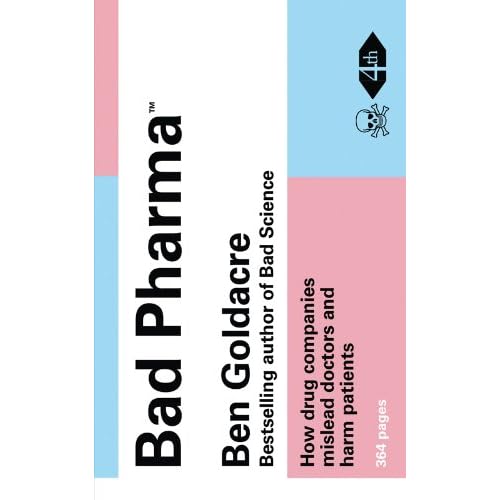
Here's Ben Goldacre holding the first copy of his new book "Bad Pharma" (I will hold mine tonight, squee):

Those of you who have followed the story of "Bad Science" will know that the first edition was missing a chapter, because the dangerous quack discussed in that story was suing Dr. Goldacre. The chapter appeared online after the law suit and was added to the second edition of the book.

Now Ben might be facetious when he asks his readers to buy the book before it gets pulled, but it is not an unrealistic worry given his previous experience and industry practise. What can you expect? Luckily, Ben Goldacre generously shares the whole Introduction here:
For those of you in the US - ask a European friend to send you the book or bridge the time until January 2013 with reading Ben's excellent blog.
NOTE: I linked toAmazon.co.uk and Amazon.com up there, but if you have a chance, support your local book store and buy it there.
Edited to add: David Colquhoun, the excellent pharmacologist and skeptic has weighed in. I have changed the book link to a store which pays taxes in the UK following his example.

Those of you who have followed the story of "Bad Science" will know that the first edition was missing a chapter, because the dangerous quack discussed in that story was suing Dr. Goldacre. The chapter appeared online after the law suit and was added to the second edition of the book.

Now Ben might be facetious when he asks his readers to buy the book before it gets pulled, but it is not an unrealistic worry given his previous experience and industry practise. What can you expect? Luckily, Ben Goldacre generously shares the whole Introduction here:
In short - the book that everyone should read and that could be the beginning of something amazingly beautiful: evidence-based medicine.So to be clear, this whole book is about meticulously defending every assertion in the paragraph that follows.Drugs are tested by the people who manufacture them, in poorly designed trials, on hopelessly small numbers of weird, unrepresentative patients, and analysed using techniques which are flawed by design, in such a way that they exaggerate the benefits of treatments. Unsurprisingly, these trials tend to produce results that favour the manufacturer. When trials throw up results that companies doesn’t like, they are perfectly entitled to hide them from doctors and patients, so we only ever see a distorted picture of any drug’s true effects. Regulators see most of the trial data, but only from early on in its life, and even then they don’t give this data to doctors or patients, or even to other parts of government. This distorted evidence is then communicated and applied in a distorted fashion. In their forty years of practice after leaving medical school, doctors hear about what works through ad hoc oral traditions, from sales reps, colleagues or journals. But those colleagues can be in the pay of drug companies – often undisclosed – and the journals are too. And so are the patient groups. And finally, academic papers, which everyone thinks of as objective, are often covertly planned and written by people who work directly for the companies, without disclosure. Sometimes whole academic journals are even owned outright by one drug company. Aside from all this, for several of the most important and enduring problems in medicine, we have no idea what the best treatment is, because it’s not in anyone’s financial interest to conduct any trials at all. These are ongoing problems, and although people have claimed to fix many of them, for the most part, they have failed; so all these problems persist, but worse than ever, because now people can pretend that everything is fine after all.
For those of you in the US - ask a European friend to send you the book or bridge the time until January 2013 with reading Ben's excellent blog.
NOTE: I linked to
Edited to add: David Colquhoun, the excellent pharmacologist and skeptic has weighed in. I have changed the book link to a store which pays taxes in the UK following his example.